

In the precision-driven world of modern software development, where automated test suites and CI/CD pipelines promise speed and repeatability, a contrasting and profoundly human-centered practice thrives: exploratory testing. Often misunderstood as random “clicking around,” exploratory testing is a disciplined, intellectual, and highly valuable approach where testing is simultaneously designed and executed. The tester’s knowledge, intuition, and creativity become the primary tools to investigate software, learn about its behavior, and uncover subtle, high-impact bugs that scripted tests often miss.
As we navigate 2026, with applications growing in complexity and user expectations at an all-time high, the role of the exploratory tester is more critical than ever. Automation excels at verifying what we already know to expect, but exploratory testing is the art of discovering the unknown—the unexpected behaviors, the confusing user journeys, and the edge cases that exist outside the mapped requirements. This guide delves into the philosophy, techniques, and strategic implementation of exploratory testing, positioning it not as an alternative to automation, but as its essential complement in the pursuit of exceptional software quality.
Beyond the Script: The Philosophy of Exploratory Testing
At its core, exploratory testing reframes the testing activity. Instead of a two-stage process of first designing rigid test cases and then mindlessly executing them, it integrates test design, execution, and learning into a concurrent, iterative flow. The tester is an investigator, not just a verifier.
Cem Kaner, who coined the term, defines it as “a style of software testing that emphasizes the personal freedom and responsibility of the individual tester to continually optimize the quality of his/her work by treating test-related learning, test design, test execution, and test result interpretation as mutually supportive activities that run in parallel throughout the project.”
This mindset shift is built on three interdependent pillars:
-
Learning: The tester actively explores the application to build a mental model of its functionality, architecture, and potential risk areas.
-
Test Design: In real-time, the tester designs experiments and probes based on their evolving understanding and observations.
-
Execution: These improvised tests are executed immediately, and their results directly inform the next cycle of learning and design.
This creates a powerful feedback loop where discovery fuels further investigation, allowing testers to dive deep into complex, emergent behaviors that a predefined script could never anticipate.

The exploratory testing cycle: learning, designing, and executing are not sequential phases but concurrent activities that continuously fuel discovery and insight.
Core Techniques and Structured Approaches
While exploratory testing is inherently flexible, it is not chaotic. Professional testers employ structured techniques to focus their efforts and maximize effectiveness. These are some of the most powerful heuristics and approaches:
1. Tours and Personas
This technique involves “touring” the application with a specific theme or user persona in mind, providing structure to the exploration.
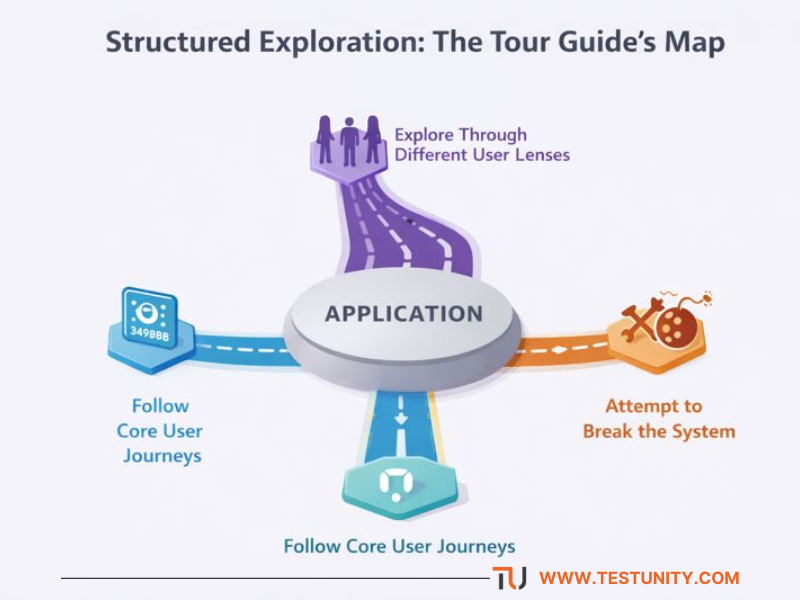
Exploratory testing ‘tours’ provide thematic structure for investigation, guiding testers to examine an application from specific, mission-focused perspectives.
- The Guidebook Tour: Test the application as a new user following the main happy paths, like a tourist following a guidebook. This checks core functionality and first impressions.
- The Saboteur Tour: Actively attempt to break the system by entering invalid data, disrupting workflows, or trying unlikely sequences of actions.
- The Persona-Based Tour: Adopt the mindset of a specific user persona (e.g., “a hurried parent,” “a tech-averse senior,” “a power user”) to evaluate the experience from diverse perspectives.
2. Heuristic Test Strategy Models (HTSM)
HTSM provides a set of mental guide rails for designing tests. Testers use mnemonics to ensure broad coverage. A common one is SFDPOT:
-
Structure: Test the code, hardware, or file structures.
-
Function: Test what the application is supposed to do.
-
Data: Test with various data types, sizes, and states.
-
Platform: Test how the application interacts with OS, browsers, APIs, and hardware.
-
Operations: Test install, startup, shutdown, and recovery.
-
Time: Test performance, concurrency, and time-sensitive functions.
3. Session-Based Test Management (SBTM)
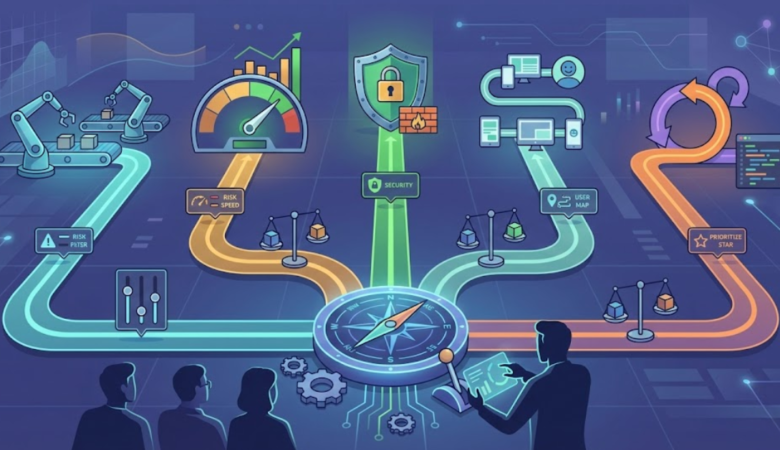
SBTM introduces accountability and measurability to exploratory testing without sacrificing its adaptive nature. Testing is organized into uninterrupted, time-boxed sessions (typically 60-120 minutes), each with a clear charter (a mission statement, e.g., “Explore the new checkout workflow to assess its reliability under network interruptions”).

he Session-Based Test Management (SBTM) framework provides structure for exploratory testing, turning open-ended investigation into a measurable, repeatable process that generates actionable insights.
After a session, the tester produces a brief report detailing what was tested, what was found, and any bugs logged. This allows teams to plan, review, and quantify the value of exploratory efforts.
The Strategic Value in Modern Development Lifecycles
In Agile and DevOps environments, exploratory testing fills crucial gaps that automation cannot.
-
Rapid Feedback on New Features: When a new feature or UI is still in a fluid state, writing automated scripts is premature and wasteful. Exploratory testing provides immediate, insightful feedback to developers, shaping the feature’s quality from its inception.
-
Uncovering Usability and UX Issues: Automation checks if a button works; exploratory testing evaluates if the button is intuitive, placed correctly, and provides appropriate feedback. It is the primary method for assessing the subjective quality of the user experience.
-
Testing Complex, Real-World Scenarios: How does the application behave when a database call times out in the middle of a multi-step wizard? What happens if a user switches browser tabs and comes back later? Exploratory testing simulates the chaotic, real-world usage patterns that are impossible to fully script.
-
Investigating Bug Reports and Outages: When a bug is reported or an incident occurs, exploratory testers are excellent forensic investigators. They can replicate the issue, explore its boundaries, and discover if related areas are also affected.
A Comparative Lens: Exploratory vs. Scripted Testing
Understanding exploratory testing is easier when contrasted with its scripted counterpart. They are not opposites but two essential tools on a quality spectrum.
| Aspect | Exploratory Testing | Scripted (Automated/Manual) Testing |
|---|---|---|
| Primary Goal | Discover unknown information, risks, and bugs. | Verify known requirements and prevent regression. |
| Design & Execution | Concurrent and iterative. | Sequential and separate. |
| Knowledge Source | Tester’s skill, intuition, and real-time learning. | Pre-written test cases or automation scripts. |
| Best For | Evaluating usability, investigating complex systems, testing new features. | Regression suites, performance validation, repetitive checks. |
| Documentation | Notes, bug reports, session debriefs. | Detailed test cases, step-by-step scripts. |
| Outcome | New insights, uncovered bugs, improved understanding of risk. | Pass/Fail status, confirmation of existing behavior. |

A complete quality assurance strategy harnesses the precision of scripted testing to guard existing functionality and the creativity of exploratory testing to uncover new risks and insights.
A balanced QA strategy leverages both. Automated regression testing protects the existing core, while exploratory testing investigates the new and uncertain frontier.
Cultivating the Explorer Mindset: Skills and Best Practices
Effective exploratory testing relies more on the tester’s cognitive abilities than on tools. Key skills and practices include:
-
Critical Thinking & Curiosity: A relentless desire to ask “What if?” and “Why does it do that?”
-
Systematic Note-Taking: Using tools as simple as notepads or as sophisticated as dedicated session management tools to document findings, questions, and bug evidence in real-time.
-
Risk-Based Thinking: Continuously prioritizing what to test next based on perceived risk, complexity, and change.
-
Effective Bug Reporting: Since the tests are not pre-scripted, clearly articulating how a bug was found and how to reproduce it is paramount.
-
Time Management: Staying focused on the session charter while being adaptable enough to follow promising leads.
Tools to Enhance (Not Replace) Exploration
While the human mind is the primary tool, several technologies can augment the process:
-
Screen Capture & Note-Taking: Tools like Snagit or Loom allow testers to quickly capture screenshots, videos, and annotated notes without breaking flow.
- Session Management: Tools like
qTest ExplorerorTestRailwith exploratory features help plan charters, track time, and structure session reporting. -
API Exploration Tools: Postman or Insomnia can be used exploratorily to probe APIs with unexpected payloads and sequences.
-
Simple Automation for Setup: Using scripts to create complex test data or system states, freeing the tester to focus on exploration rather than tedious setup.
Implementing Exploratory Testing in Your Team
Integrating exploratory testing into a development process requires a shift in perspective and some practical steps:
-
Start with a Champion: Identify a curious, critical-thinking tester to pioneer the approach and demonstrate its value through concrete findings.
-
Educate the Team: Explain to developers, product owners, and managers what exploratory testing is and is not. Frame it as a skilled investigation, not unstructured play.
-
Formalize with Sessions: Adopt Session-Based Test Management. Begin by scheduling dedicated, uninterrupted exploration time, even if it’s just a few hours per sprint.
-
Focus on High-Value Areas: Direct exploratory efforts towards the most change-prone, complex, or customer-critical parts of the application.
-
Review and Adapt: Regularly review session reports and findings in team meetings. Use the insights to improve both the product and the testing process itself.
Conclusion: The Indispensable Human Element in Quality Assurance
As we advance further into an era of intelligent automation, the unique value of human cognition, intuition, and adaptability only increases. Exploratory testing embodies this value. It is the practice that ensures our software is not just functionally correct but is also robust, intuitive, and resilient in the face of unpredictable real-world use.
It champions the idea that quality is more than a checklist—it is a multidimensional attribute discovered through critical engagement and skilled investigation. By formally embracing exploratory testing alongside automated verification, organizations build a truly comprehensive and resilient quality assurance strategy. They empower their testers not just to confirm that the software was built right, but to help discover if the right software was built.
Read our Detailed Blog on Complete Guide to Types of Software Testing, Levels & Methods.

TestUnity is a leading software testing company dedicated to delivering exceptional quality assurance services to businesses worldwide. With a focus on innovation and excellence, we specialize in functional, automation, performance, and cybersecurity testing. Our expertise spans across industries, ensuring your applications are secure, reliable, and user-friendly. At TestUnity, we leverage the latest tools and methodologies, including AI-driven testing and accessibility compliance, to help you achieve seamless software delivery. Partner with us to stay ahead in the dynamic world of technology with tailored QA solutions.







Very interesting points you have mentioned, appreciate it for posting.
Thank you for your kind words! We’re glad you found the points interesting. We appreciate your support!
i enjoy reading your articles, it is simply amazing, you are doing great work, do you post often? i will be checking you out again for your next post. you can check out webdesignagenturnürnberg.de the best webdesign agency in nuremberg Germany
That is the precise weblog for anybody who needs to find out about this topic. You notice so much its virtually laborious to argue with you (not that I truly would need…HaHa). You definitely put a brand new spin on a subject thats been written about for years. Nice stuff, simply great!
Hi, i think that i saw you visited my blog thus i came to “return the favor”.I am attempting to find things to enhance my web site!I suppose its ok to use some of your ideas!!
feel free to do so