

You have a suite of thousands of automation testing scripts. Your CI/CD pipeline shows a glowing 95% code coverage. The build is green. Everyone feels confident. But what if this confidence is an illusion? What if your tests, while extensive, are like a security guard who clocks in but falls asleep—present, yet completely ineffective at catching real intruders?
This is the critical problem mutation testing solves. It is the most rigorous method available to answer a deceptively simple question: How good are my tests, actually?
While unit testing checks if your code works, and code coverage tells you how much of it was executed, mutation testing challenges the intellectual integrity of your test suite itself. It is the cornerstone of a true quality engineering mindset, shifting the focus from “do we have tests?” to “do we have meaningful tests?” This guide will take you from understanding its core philosophy to implementing its advanced strategies.
The Philosophical Shift: From Checking Boxes to Ensuring Strength
Most testing metrics are quantitative. Mutation testing is uniquely qualitative. It operates on a fault-based hypothesis:
“A good test suite should be able to detect small, deliberate bugs (mutations) injected into the source code. If it cannot, it has a fundamental weakness.”
Think of it not as another test to run, but as a quality audit for your tests. It doesn’t care if your tests pass for the right code; it cares if they fail for the wrong code. This mindset is what separates functional validation from genuine quality assurance.
The Core Mechanics: A Deep Dive into the Mutation Process
Let’s dissect the process beyond the basic “create mutants and run tests” explanation.
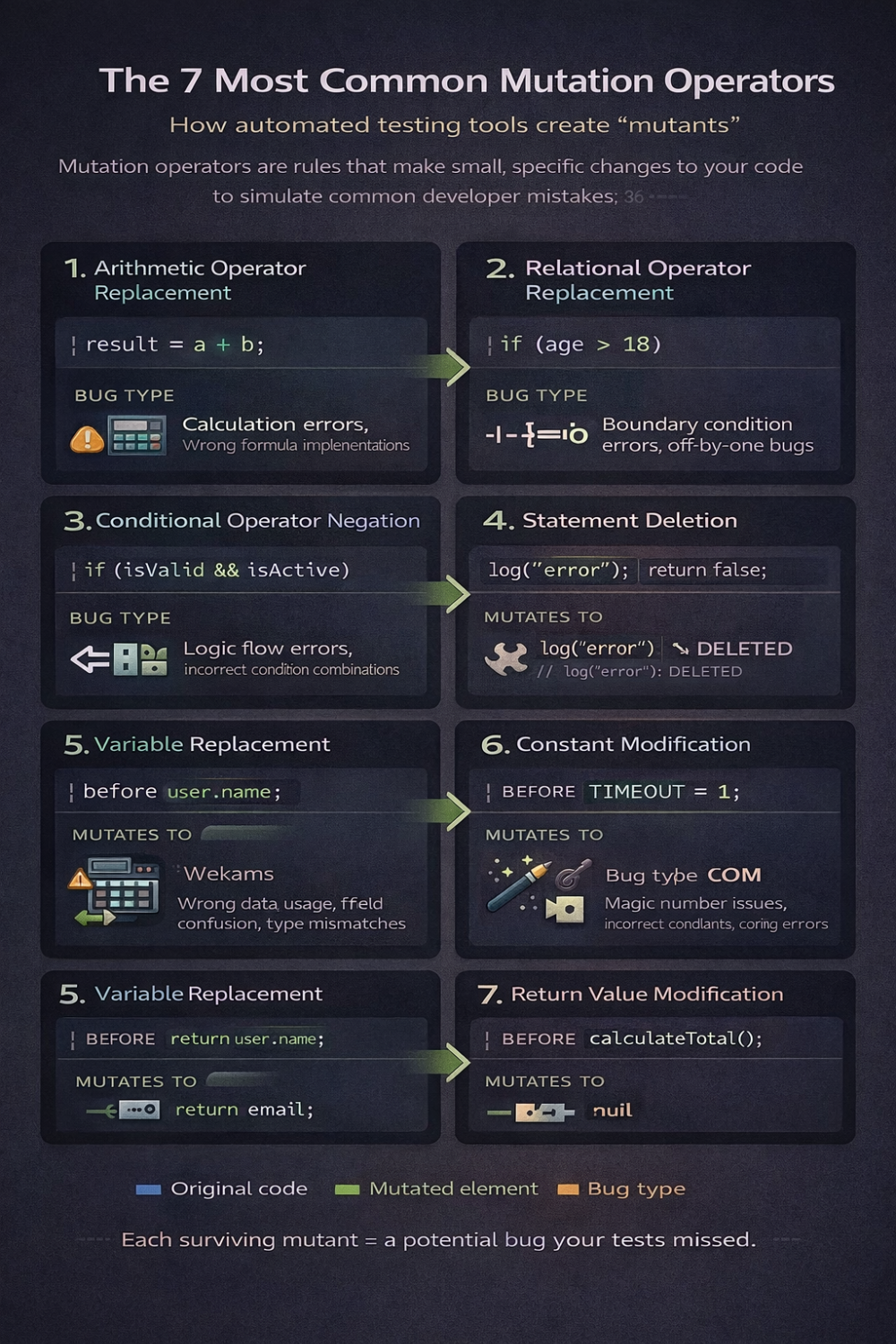
The seven most common mutation operators. These small, deliberate code faults simulate typical developer mistakes. If your tests don’t fail when these mutations are present, it reveals a significant gap in your test logic.
1. The Anatomy of a Mutant
A mutant is not a random garbage change. Mutation testing tools use formal, granular rules called mutation operators to create semantically plausible errors. Common operators include:
-
Arithmetic Operator Replacement (AOR): Changing
+to-,*to/, etc.-
Original:
int total = price + fee; -
Mutant:
int total = price - fee;
-
-
Relational Operator Replacement (ROR): Changing
>to>=,==to!=, etc.-
Original:
if (user.age > 18) { ... } -
Mutant:
if (user.age >= 18) { ... }
-
-
Conditional Boundary Negation (CBN): Altering boundary conditions.
-
Original:
for (int i = 0; i < list.size(); i++) -
Mutant:
for (int i = 0; i <= list.size(); i++)// Likely causes anIndexOutOfBoundsException
-
-
Statement Deletion (STD): Removing an entire statement to see if its absence is detected.
-
Original:
log.info("Transaction processed: " + id); return repository.save(obj); -
Mutant:
//log.info... DELETED return repository.save(obj);
-
The sophistication lies in the fact that these mutations mimic the exact types of errors developers make—typos, off-by-one errors, flipped logic.
2. The Lifecycle and Fate of a Mutant
When your test suite runs against a mutant, three outcomes are possible:
-
Killed: At least one test fails. This is success. Your test suite detected the anomaly.
-
Survived: All tests pass. This is a critical finding. Your suite cannot distinguish the buggy code from the correct code.
-
Stillborn/Equivalent: The mutant is syntactically flawed and won’t compile, or it is semantically equivalent to the original code (a major challenge we’ll address later).
The Mutation Score is the key metric:
Mutation Score = (Killed Mutants / (Total Mutants - Equivalent Mutants)) * 100
A score of 100% is the ideal, but often impractical. A score of 80%+ on core logic indicates a very robust suite.
Advanced Concepts Made Simple
1. The “Equivalent Mutant” Problem: The Ghost in the Machine
This is the most significant technical challenge in mutation testing. An equivalent mutant is a mutated version of the code that is functionally identical to the original, despite the syntactic change.
Example:
// Original
public boolean isAdult(int age) {
    return age >= 18;
}

// Mutant (Relational Operator Replacement: >= to >)
public boolean isAdult(int age) {
    return age > 18;
}
Is age > 18 equivalent to age >= 18? For integer age, no. isAdult(18) returns true for the original and false for the mutant. It’s a valid, killable mutant.
But consider:
// Original
int absoluteValue(int x) {
    if (x >= 0) return x;
    else return -x;
}

// Mutant (Change >= to >)
int absoluteValue(int x) {
    if (x > 0) return x; // Changed line
    else return -x;
}
For x = 0, both versions return 0. The mutant is functionally equivalent. No test can kill it. Detecting these automatically is an undecidable problem (a variant of the Halting Problem). They create noise, inflating the total mutant count and artificially lowering your score. Advanced tools use complex static analysis to reduce them, but manual review is sometimes needed for a perfect score.

he case of the undetectable bug. Equivalent mutants are the ‘ghosts’ of mutation testing—faults in the code that don’t change its behavior. Distinguishing a true test weakness from these phantom bugs requires a detective’s eye for logic, mathematics, and domain knowledge. Can you solve all three cases?
2. Mutant Schemata: The Engine of Efficiency
Running thousands of compiled mutants is slow. Modern tools like PIT for Java use a Mutant Schemata approach. Instead of creating separate physical copies of the code, they inject all potential mutations into a single instrumented version of the original code. A special runtime engine then activates one mutation at a time during test execution. This reduces overhead by 90% or more, making the technique feasible for real projects.

The dangerous gap between execution and protection. High line coverage creates a false sense of security, while mutation testing reveals how many synthetic bugs your tests actually catch. A test suite can execute every line yet still miss critical logic flaws.
A Practical, Detailed Walkthrough: From Code to Insight
Let’s move beyond a trivial calculate_discount function to a more realistic example.
Scenario: A User Authentication Service Method
public class AuthService {
    /**
     * Authenticates a user.
     * @param username The username
     * @param password The plaintext password
     * @param loginContext Contains IP, user-agent for rate-limiting
     * @return an AuthenticationResult object
     */
    public AuthenticationResult authenticate(String username, String hashedPassword, LoginContext loginContext) {
        // 1. Rate limiting check
        if (rateLimiter.isBlocked(loginContext.getIp())) {
            log.warn("Blocked IP attempt: " + loginContext.getIp());
            return AuthenticationResult.blocked();
        }

        // 2. Find user
        User user = userRepository.findByUsername(username);
        if (user == null) {
            // Security: Use same delay as valid user to prevent timing attacks
            SecurityUtil.delay();
            return AuthenticationResult.failed();
        }

        // 3. Validate password hash
        boolean passwordValid = PasswordHasher.verify(hashedPassword, user.getPasswordHash());
        if (!passwordValid) {
            log.warn("Invalid password for user: " + username);
            return AuthenticationResult.failed();
        }

        // 4. Check if account is active
        if (!user.isActive()) {
            return AuthenticationResult.inactive();
        }

        // 5. Success
        log.info("Successful login for user: " + username);
        return AuthenticationResult.success(user);
    }
}
Our Initial Test Suite (with High Coverage):
@Test
public void testAuthenticate_Success() {
    User mockUser = new User("test", "hash_abc", true);
    when(userRepo.findByUsername("test")).thenReturn(mockUser);
    when(PasswordHasher.verify("hash_abc", "hash_abc")).thenReturn(true);

    AuthenticationResult result = authService.authenticate("test", "hash_abc", context);
    assertTrue(result.isSuccess());
}

@Test
public void testAuthenticate_UserNotFound() {
    when(userRepo.findByUsername("unknown")).thenReturn(null);
    AuthenticationResult result = authService.authenticate("unknown", "pwd", context);
    assertTrue(result.isFailed());
}

// ... tests for inactive user, blocked IP, etc.
Mutation Testing in Action: The Revealing Gaps
A mutation tool will create dozens of mutants. Let’s analyze critical survivors:
-
Mutant on Line 12 (Logging):
log.warn(...)mutated to//log.warn(...) DELETED.-
Will it survive? Yes. Our tests assert on the
AuthenticationResultobject, not on whether a log was written. This reveals a test design gap: we are missing verification of important side-effects (logging for audit trails). This is a common issue in integration testing.
-
-
Mutant on Line 18 (Timing Attack Defense):
SecurityUtil.delay();is deleted.-
Will it survive? Almost certainly. It’s incredibly difficult to write a unit test that detects the presence or absence of a deliberate delay. This mutant is likely equivalent from the unit test’s perspective, teaching us that some security features are validated at the code review or integration level, not the unit level.
-
-
Mutant on Line 23 (Logic Flip): Change
!passwordValidtopasswordValid.-
Will it survive? No. Our success path test would fail because it would return
AuthenticationResult.failed()instead of success. Killed. Good.
-
-
Mutant on Line 27 (Conditional Boundary): Change
!user.isActive()touser.isActive().-
Will it survive? Only if we lack a test for an inactive user. If we have that test, it will kill this mutant.
-
This analysis forces critical conversations: Should we test logging? Can we? How do we validate security-hardening code? Mutation testing doesn’t just give answers; it reveals the subtle, often overlooked questions about what “correctness” truly means.
Strategic Implementation: A Pragmatic Roadmap
Given its computational cost, you must be strategic.
Phase 1: Pilot (Weeks 1-2)
-
Target: Select one core, domain-critical library (e.g.,
payment-calculator,security-tokens). Avoid UI or glue code. -
Tooling: Integrate a best-in-class tool (PITest for Java, Stryker Mutator for JS/TS/C#, MutPy for Python) into the module’s build. Configure it to run only on this module.
-
Goal: Get a baseline score. Don’t try to improve it yet. Just understand the output.
Phase 2: Analyze & Establish Baselines (Weeks 3-4)
-
Workshop: Gather the team. Review the top 10 surviving mutants. Categorize them:
-
Missing Test: A clear logic bug the tests missed. Action: Write a targeted test.
-
Equivalent Mutant: A ghost. Action: Mark it as such in the tool’s config to exclude it.
-
Hard-to-Test Side Effect: Like logging. Action: Discuss as a team—is a test needed? If so, can we refactor to make it testable (e.g., inject a
AuditLoggerinterface)?
-
-
Set a Realistic Goal: For a pilot module, a 75% mutation score is an excellent initial target.
Phase 3: Integrate & Scale (Month 2+)
-
CI Integration: Run mutation tests as a nightly job or a post-merge gate for the
mainbranch of the piloted module. Do not run it on every pull request—it’s too slow. -
Track the Trend: Chart the mutation score over time in your quality metrics dashboard. The trend (improving) is more important than the absolute number.
-
Expand Gradually: Roll out to other critical services, learning from the pilot.

The quality investment curve. Like any strategic initiative, mutation testing requires upfront investment in weeks 1-4. The ROI turns positive in months 2-3 as the test suite strengthens, and compounds into months 4+ with preventive bug catching and unblocked development velocity. The data shows it’s not a cost—it’s a high-yield investment in engineering efficiency.
The Future: AI and the Next Evolution
Mutation testing is poised for a revolution with AI-powered test generation. The current process is a one-way street: mutants reveal test weaknesses, and developers improve tests manually. The next step is a closed feedback loop:
-
The mutation tool identifies a surviving mutant.
-
An AI-based test generation system analyzes the mutant and the original code.
-
The AI synthesizes a new, focused test case designed specifically to kill that mutant.
-
The new test is proposed to the developer or added automatically to the suite.
This creates a self-healing, continuously improving test suite. Furthermore, AI can generate more intelligent, semantic mutants that go beyond simple operator swaps to mimic complex bug patterns found in your actual codebase history, making the audit even more realistic.
Conclusion: The Hallmark of Engineering Rigor
Adopting mutation testing is a declaration of maturity. It says, “We are done counting our tests; we are now invested in measuring their strength.” It is the practice that most clearly aligns with the rigorous, evidence-based mindset of true software engineering.
It completes the software testing hierarchy:
-
Unit Tests verify your code works.
-
Integration Tests verify your components work together.
-
Mutation Tests verify your verifications are valid.
While it may not be necessary for every single module in your application, applying it to your core business logic, security, and financial engines is an investment in unparalleled confidence. It transforms your test suite from a cost center into a rigorously audited, high-value asset.
To deepen your understanding of how mutation testing fits within a comprehensive testing strategy, explore our foundational guide on the different types of software testing.

TestUnity is a leading software testing company dedicated to delivering exceptional quality assurance services to businesses worldwide. With a focus on innovation and excellence, we specialize in functional, automation, performance, and cybersecurity testing. Our expertise spans across industries, ensuring your applications are secure, reliable, and user-friendly. At TestUnity, we leverage the latest tools and methodologies, including AI-driven testing and accessibility compliance, to help you achieve seamless software delivery. Partner with us to stay ahead in the dynamic world of technology with tailored QA solutions.









I like how you frame mutation testing as a reality check on the *meaningfulness* of tests, not just their existence—high coverage can definitely hide weak assertions. One thing I’ve seen teams struggle with is managing equivalent mutants and runtime cost, so tying mutation testing to critical modules first feels like a practical takeaway from your roadmap. It really reinforces the shift from chasing metrics to building confidence that tests would actually catch real bugs.
Thank you for your thoughtful comment! We’re glad you found the perspective on mutation testing valuable. Focusing on critical modules is a smart approach to manage equivalent mutants and enhance confidence in our tests. We appreciate your insights!
i enjoy reading this great article, i have shared it many times on my website and started following you, Do you post more often ?? i am the owner of https://webdesignagenturbayreuth.de/ a webdesign agency in bayreuth Germany, webdesign agentur bayreuth, you can link up if you are interested. Thank you
wow your article is simply a masterpiece, i like that, keep it up and will be checking for new update. do you post often? you can check the biggest webdesign freelancer in platform in germany called https://webdesignfreelancerfrankfurt.de/ Thank you for your wonderful post
I haven?¦t checked in here for some time as I thought it was getting boring, but the last several posts are great quality so I guess I will add you back to my everyday bloglist. You deserve it my friend 🙂