
As we move into 2026, the pressure on software teams to deliver higher-quality applications at unprecedented speed has never been greater. In this landscape, manual testing alone is a bottleneck to innovation, growth, and market competitiveness. This is where strategic test automation services transition from a technical convenience to a critical business imperative.
Far more than just scripting repetitive tasks, modern test automation services represent a holistic approach to building quality into the very fabric of your development lifecycle. They encompass strategy, framework architecture, intelligent execution, and continuous analysis. This complete guide will navigate the evolving world of test automation, explaining its undeniable value, the spectrum of services available, key implementation strategies for 2026, and how to choose the right partner to transform your software delivery.
Why Test Automation Services Are Non-Negotiable in 2026
The business case for automation is clear and compelling. It’s the engine that powers continuous delivery and DevOps excellence.
-
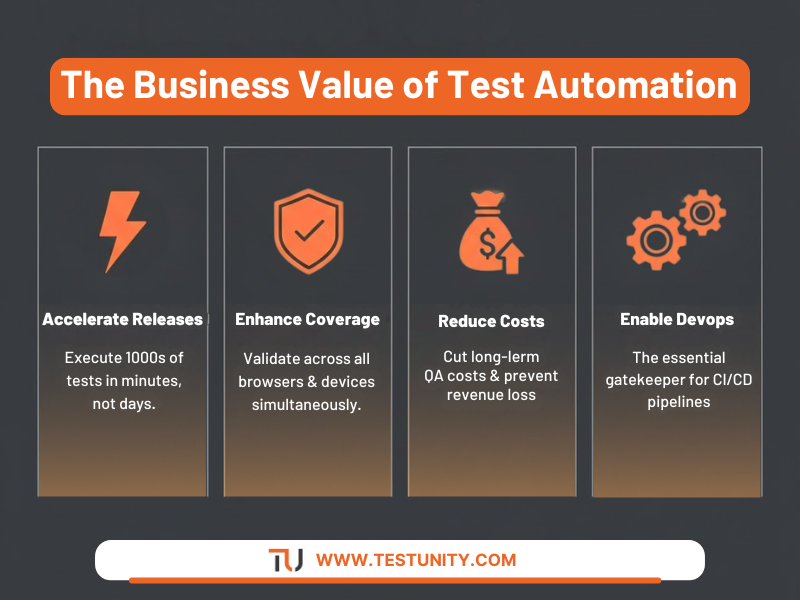
Accelerated Release Velocity: Automated tests execute in minutes or hours, not days or weeks. This rapid feedback loop allows developers to identify and fix defects immediately, significantly reducing cycle times and enabling reliable, weekly or even daily releases.
-
Enhanced Test Coverage and Reliability: Automation can easily execute thousands of complex test cases across multiple browsers, devices, and operating systems—a feat impossible manually. This ensures every code change is validated against a vast matrix of scenarios, dramatically improving application robustness.
-
Substantial Cost Reduction & Superior ROI: While there is an upfront investment, the long-term savings are profound. Automation reduces the high cost of manual regression testing, minimizes revenue loss from production bugs, and frees your skilled QA engineers to focus on exploratory testing, user experience, and strategic quality initiatives.
-
Foundational Support for CI/CD & DevOps: Automated testing is the critical quality gate in a Continuous Integration/Continuous Deployment (CI/CD) pipeline. Without it, you cannot achieve true continuous delivery. Services specializing in CI/CD integration ensure your tests are a seamless, reliable part of the automated build and deployment process.
The Comprehensive Spectrum of Modern Test Automation Services
A mature test automation services partner offers more than just execution. They provide a full-stack solution tailored to your application’s architecture and business goals.
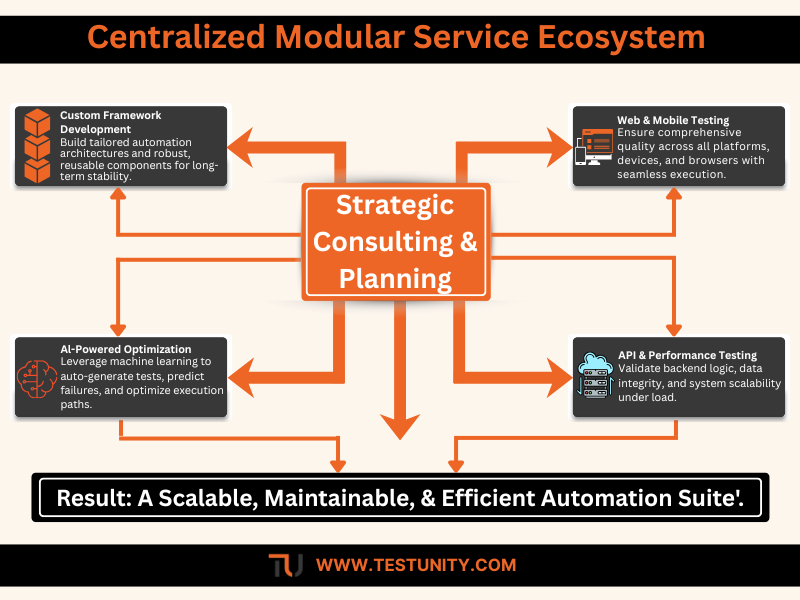
1. Strategic Test Automation Consulting & Planning
This is the crucial first step. Experts will assess your application’s technology stack, architecture, and business risks to develop a tailored automation roadmap. This includes:
-
Feasibility & ROI Analysis: Identifying the most valuable areas to automate for maximum return.
-
Tool & Framework Selection: Recommending the optimal stack (e.g., Selenium, Cypress, Playwright, Appium, RestAssured) based on your needs, not just trends.
-
Testing Pyramid Strategy: Designing the right balance of unit, API, and UI tests to create a fast, stable, and maintainable suite.
2. Custom Automation Framework Development
An off-the-shelf tool is not a framework. Service providers build robust, scalable, and maintainable test automation frameworks that serve as the foundation for all your scripts. Key architectures include:
-
Data-Driven Frameworks: Separate test data from script logic for easy maintenance and scalability.
-
Keyword-Driven Frameworks: Use a vocabulary of reusable actions, making test creation accessible to less technical team members.
-
Hybrid Frameworks: Combine the best of multiple approaches to fit complex project needs.
-
Modern Features: Built-in reporting, seamless CI/CD hooks, cloud device farm integrations, and parallel execution capabilities.
3. Specialized Automation Service Tracks
-
Web Automation Testing Services: Ensuring flawless functionality and user experience across all major browsers (Chrome, Firefox, Safari, Edge) and versions using tools like Selenium WebDriver, Cypress, or Playwright.
-
Mobile Automation Testing Services: Validating native, hybrid, and web applications across hundreds of real iOS and Android devices and simulators using Appium, Espresso, or XCUITest.
-
API Automation Testing Services: The most critical layer for modern microservices architectures. Automating RESTful and SOAP APIs with tools like Postman, RestAssured, or SoapUI to ensure backend reliability, performance, and contract integrity.
-
Performance Test Automation: Scripting and executing automated load, stress, and endurance tests using tools like k6, JMeter, or Gatling to validate application scalability and stability under peak traffic.
4. AI-Powered Test Automation & Optimization
This is a key differentiator for 2026. Leading services now integrate Artificial Intelligence and Machine Learning to overcome traditional automation challenges:
-
AI-Based Test Generation: Analyzing application behavior and user traffic to automatically generate and prioritize intelligent test cases.
-
Self-Healing Tests: Using machine learning to automatically update brittle element locators when the UI changes, drastically reducing maintenance overhead.
-
Visual Validation with AI: Automatically detecting visual regressions and UI glitches that traditional functional scripts might miss.
-
Smart Analytics & Reporting: Moving beyond pass/fail counts to predictive insights, identifying high-risk code areas and optimizing test suites for efficiency.
The Implementation Journey: From Assessment to Autonomy
A successful automation program follows a structured, phased approach.
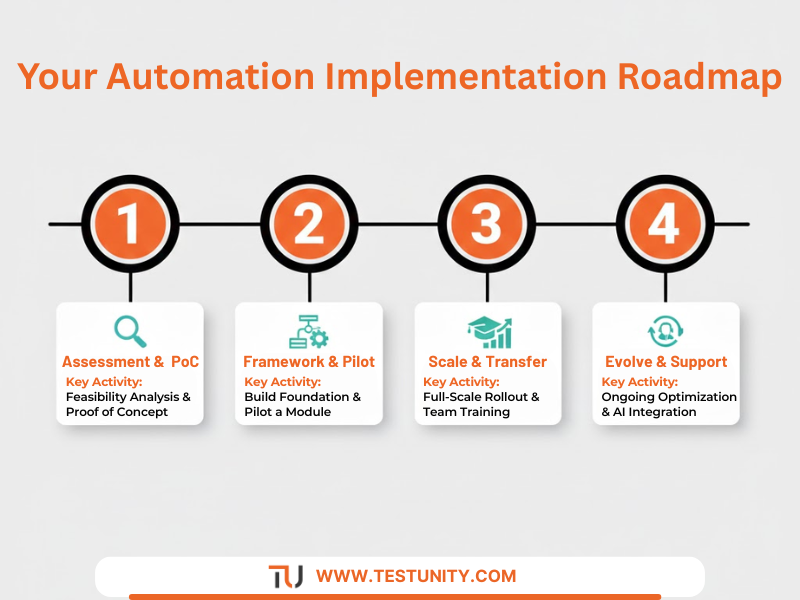
Phase 1: Assessment & Proof of Concept (PoC)
The partner conducts a deep-dive audit of your application and processes. They then develop a small, focused PoC on a critical user journey to demonstrate feasibility, establish metrics, and build stakeholder confidence.
Phase 2: Framework Development & Pilot
A custom, scalable automation framework is built. A pilot project—typically a key application module—is fully automated, establishing patterns, standards, and best practices for the wider team.
Phase 3: Full-Scale Implementation & Knowledge Transfer
Automation is scaled across the application. Crucially, the service provider works alongside your team, conducting regular training sessions and workshops. This knowledge transfer ensures your internal team gains the skills to maintain, extend, and own the automation suite long-term.
Phase 4: Continuous Support & Evolution
The partnership evolves into a support model. The provider offers maintenance, handles new feature automation, optimizes existing suites, and integrates new tools and technologies (like the latest AI-based test generation techniques) to keep your strategy ahead of the curve.
Choosing the Right Test Automation Services Partner in 2026
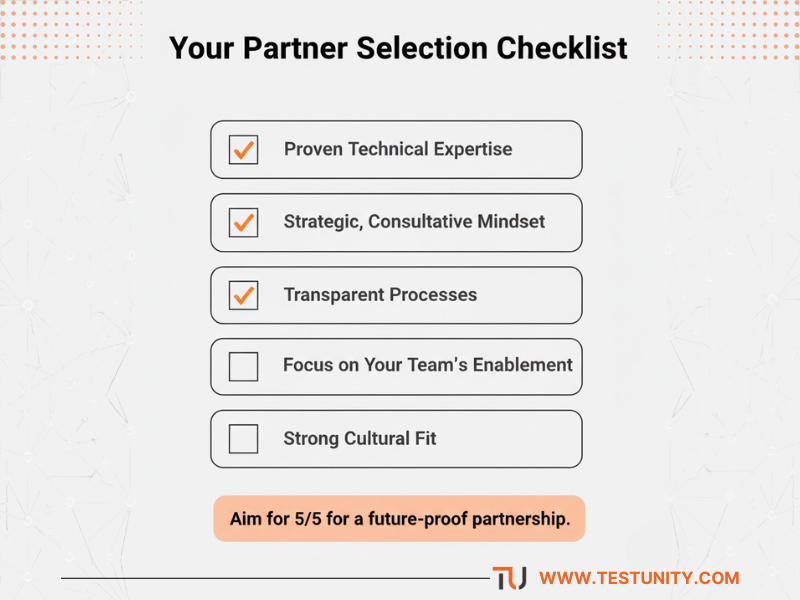
Selecting a vendor is a strategic decision. Look for these essential attributes:
-
Proven Expertise & Technical Breadth: Seek a portfolio demonstrating experience with your specific tech stack (e.g., .NET Core, React, microservices) and a wide range of tools and frameworks.
-
Strategic Mindset, Not Just Execution: The best partners act as consultants. They should ask deep questions about your business goals and product roadmap, not just your immediate testing needs.
-
Transparent Processes & Communication: Demand clear methodologies (Agile/DevOps), regular reporting cadence, and a point of contact who speaks your language—both technically and business-wise.
-
Focus on Sustainability & Enablement: Avoid partners who create “black box” automation. Choose one whose contract includes detailed documentation, training, and a clear path to transferring ownership to your team.
-
Cultural & Collaborative Fit: They should integrate seamlessly with your in-house developers, QA, and product managers, acting as a true extension of your team.
The Future of Automation: Key Trends Shaping 2026 and Beyond
To stay competitive, your automation strategy must anticipate these developments:
-
Hyperautomation & Intelligent Testing: The convergence of AI, Machine Learning, and Process Mining will lead to fully autonomous testing cycles for well-defined scenarios, with human oversight focused on complex, creative testing.
-
Shift to API & Contract Testing: As microservices and cloud-native architectures dominate, the focus of automation will solidify at the API layer. Automated contract testing will become standard to ensure service interoperability.
-
Testing in Production & Chaos Engineering: Automated, safe experiments in production (via feature flags and canary releases) and chaos engineering tests will be automated to proactively uncover systemic weaknesses.
-
Low-Code/No-Code for Citizen Testers: Platforms that allow product owners and business analysts to create automated tests through visual interfaces will expand, democratizing test creation while specialists focus on complex framework code.
Conclusion: Automating Your Path to Market Leadership
In 2026, test automation services are not a cost center; they are a strategic accelerator. They are the key to unlocking faster release cycles, impeccable quality, and the ability to innovate with confidence. The journey begins with a clear strategy, is built on a robust technical foundation, and is sustained through a partnership that values your long-term autonomy.
The question is no longer if you should automate, but how strategically you can implement it to outpace your competition.
Ready to transform your software delivery? At TestUnity, we provide more than just test automation services; we deliver a strategic partnership. From building resilient automation frameworks and integrating intelligent AI-based test generation to ensuring seamless CI/CD integration, we equip you to build quality at speed. Contact us for a free consultation, and let’s build a tailored automation roadmap to propel your success in 2026 and beyond.

TestUnity is a leading software testing company dedicated to delivering exceptional quality assurance services to businesses worldwide. With a focus on innovation and excellence, we specialize in functional, automation, performance, and cybersecurity testing. Our expertise spans across industries, ensuring your applications are secure, reliable, and user-friendly. At TestUnity, we leverage the latest tools and methodologies, including AI-driven testing and accessibility compliance, to help you achieve seamless software delivery. Partner with us to stay ahead in the dynamic world of technology with tailored QA solutions.









You have mentioned very interesting details! ps nice internet site. “By their own follies they perished, the fools.” by Homer.