

Table of Contents
ToggleIntroduction: The Strategic Imperative in Modern Software Quality
In the complex topology of modern software engineering, where release cycles are measured in hours and system failures can cascade with catastrophic business velocity, the absence of a deliberate, coherent testing strategy is not merely an operational oversight—it is an existential risk. A testing strategy transcends the tactical checklist of test cases; it is the master architectural blueprint that aligns every quality assurance activity with overarching business objectives, technological constraints, and risk posture.
This guide moves beyond foundational concepts to provide engineering leaders, principal test architects, and senior quality engineers with a doctoral-level framework for constructing, validating, and evolving a testing strategy that functions as a core competitive advantage. We will dissect the constituent elements of a world-class testing strategy, integrate advanced models from systems theory and risk management, and provide a scaffold for its practical implementation and continuous optimization.
Part I: The Foundational Pillars of a Testing Strategy
A robust testing strategy is built upon four non-negotiable pillars. These pillars form the axiomatic base from which all tactical decisions are derived.
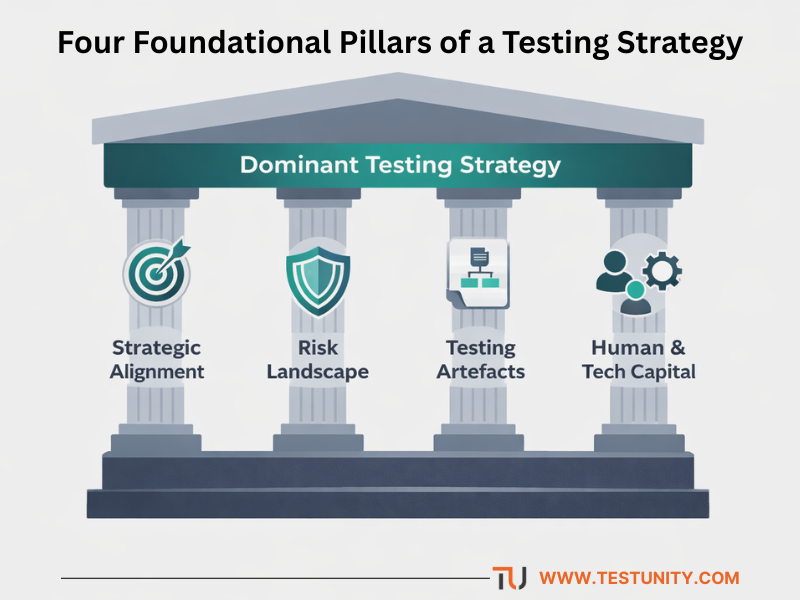
Pillar 1: Strategic Alignment – The “Why” Behind Every Test
The primary failure mode of any testing strategy is misalignment with business goals. Strategy must answer: How does testing create tangible business value?
-
Value Stream Mapping: Integrate testing activities directly into the product value stream. For a B2C e-commerce platform, the testing strategy must prioritize end-to-end transaction integrity and performance under peak load (e.g., Black Friday), directly linking to revenue protection. For a healthcare SaaS application, the strategy must be disproportionately weighted towards audit trails, data validation, and regulatory compliance (HIPAA, GDPR), linking to risk mitigation and market准入.
-
Goal Decomposition: Use frameworks like Objectives and Key Results (OKRs) to cascade business goals into test objectives. Example: *Business Objective: “Increase mobile user retention by 15%.” → Test Strategy OKR: “Achieve 99.5% stability rating for core user journeys on target mobile devices, and reduce UI-related crash reports by 40%.”* This ensures the testing strategy is a business instrument, not a technical afterthought.
Pillar 2: The Multidimensional Risk Landscape
A sophisticated testing strategy is fundamentally a risk-management protocol. It requires moving beyond a simple “high/medium/low” assessment to a multidimensional risk model.
-
Risk Dimensions:
-
Inherent Product Risk: Complexity of algorithms, novelty of technology, dependencies on third-party APIs.
-
Usage & Environmental Risk: Deployment environment (cloud vs. on-prem), user technical proficiency, network variability.
-
Business Impact Risk: Financial loss, brand equity damage, safety implications, regulatory penalties.
-
Software Supply Chain Risk: Security of open-source dependencies, integrity of CI/CD tooling.
-
-
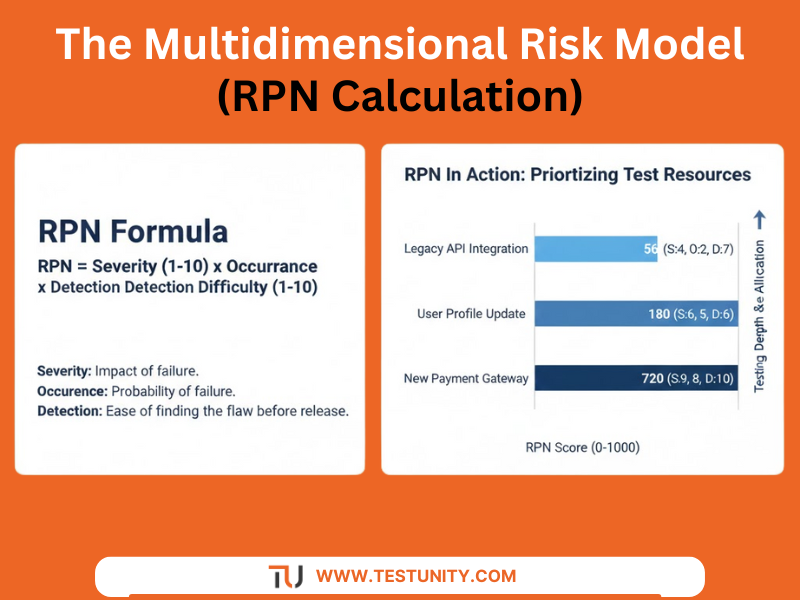
Quantitative Risk Prioritization: Employ a modified Failure Mode and Effects Analysis (FMEA). For each feature or component, calculate a Risk Priority Number (RPN):
RPN = Severity (1-10) x Occurrence Probability (1-10) x Detection Difficulty (1-10). The testing strategy must allocate depth and automation resources proportionally to the RPN, creating a mathematically defensible test plan.
Pillar 3: The Ecosystem of Testing Artefacts
Strategy is manifested through artefacts. A mature testing strategy governs the creation and maintenance of a living ecosystem of documents and models.
-
The Test Policy: A succinct, high-level document endorsed by senior leadership stating the organization’s commitment to quality and the role of testing.
-
The Test Strategy Document: The central artifact. It should articulate:
-
Test Levels & Scope: Definition of unit, integration, system, acceptance testing boundaries.
-
Test Types & Emphasis: The rationale for the mix of functional, non-functional (performance, security, usability), and specialist testing (accessibility, localization).
-
Test Design Techniques: Mandated use of techniques like Boundary Value Analysis, Decision Tables, State Transition Diagrams, and pairwise combinatorial testing for complex input spaces.
-
Test Data Management Strategy: Approach for creating, anonymizing, provisioning, and refreshing test data—a critical and often neglected component.
-
Entrance & Exit Criteria: Objective, measurable criteria for promoting a build from one test level to the next (e.g., “All critical priority unit tests pass,” “Code coverage ≥ 80%”).
-
Pillar 4: The Human & Technological Capital
A testing strategy that ignores socio-technical realities will fail. This pillar addresses capability and tooling.
-
Skills Matrix & T-Shaped Proficiency: Define the required competency matrix for the testing team—breadth across testing types (the top of the T) and depth in specializations like test automation engineering, performance engineering, or security testing (the stem of the T). The strategy must include a upskilling roadmap.
-
Toolchain Rationalization: Prescribe a coherent, integrated toolchain aligned with the technology stack. The strategy should dictate standards for:
-
Unit & Integration Testing: (e.g., JUnit, pytest, Jest).
-
API & Service Testing: (e.g., Postman, RestAssured, Karate).
-
GUI & E2E Automation: (e.g., Selenium, Cypress, Playwright) with a clear framework architecture.
-
Performance Testing: (e.g., k6, Gatling, JMeter).
-
Test Management & Traceability: (e.g., integration between Jira, test management tools, and CI/CD pipelines).
-
Part II: Advanced Strategic Models & Integration Frameworks
Model 1: The Adaptive Test Strategy Quadrant
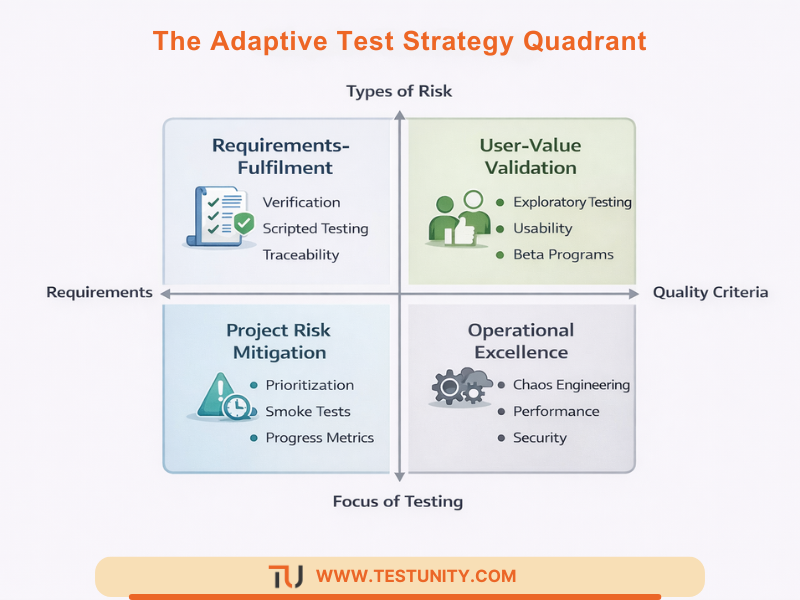
Adapting James Bach’s Heuristic Test Strategy Model, visualize your testing strategy across two axes: Product vs. Project Risks and Requirements vs. Quality Criteria. This creates four strategic foci:
-
Requirements-Fulfillment (Product/Requirements): Focused on verification against specs. Employs scripted testing, traceability matrices.
-
User-Value Validation (Product/Quality): Focused on validation of user experience and fitness for use. Employs exploratory testing, usability sessions, beta programs.
-
Project Risk Mitigation (Project/Requirements): Focused on schedule, resource, and scope risks. Employs risk-based test prioritization, smoke testing, and progress metrics.
-
Operational Excellence (Project/Quality): Focused on deployability, maintainability, and operability. Employs chaos engineering, performance benchmarking, security penetration testing.
A balanced testing strategy allocates effort across all four quadrants, adjusting the balance based on project phase.
Model 2: The Test Maturity Curve & Continuous Feedback Integration
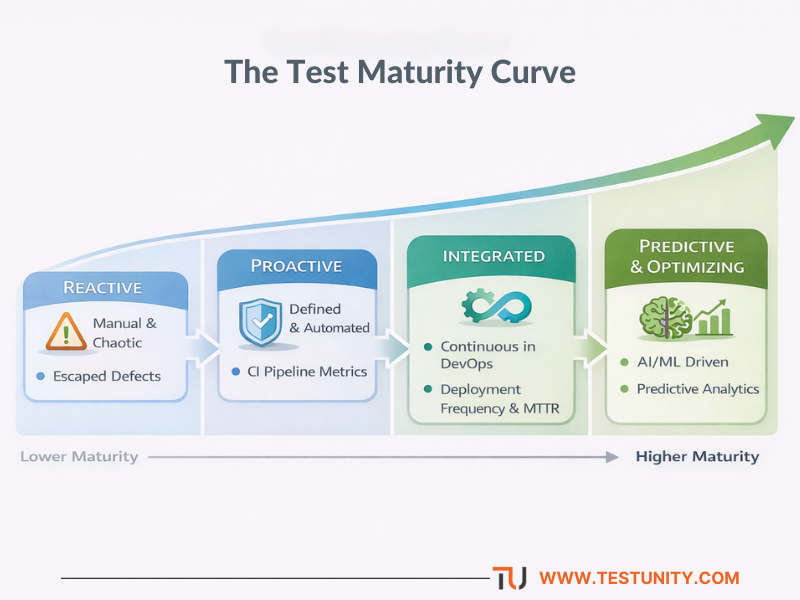
A dynamic testing strategy must evolve. Model its maturity alongside the integration of feedback loops:
| Maturity Stage | Characteristic | Primary Feedback Source | Strategic Evolution |
|---|---|---|---|
| Reactive | Testing is a final gate; manual, chaotic. | Escaped defects, production incidents. | Focus on establishing basic test automation and shift-left principles. |
| Proactive | Defined processes; automation for regression. | CI pipeline pass/fail rates, test coverage metrics. | Integrate non-functional testing; adopt risk-based prioritization models. |
| Integrated | Testing is a continuous, integrated activity in DevOps. | Deployment frequency, lead time for changes, mean time to recovery (MTTR). | Embed testing into architecture (e.g., “testability” as a design requirement); implement A/B testing and canary analysis. |
| Predictive & Optimizing | AI/ML predicts failure areas; testing is a source of business intelligence. | Predictive analytics on defect clusters, user behavior telemetry. | Strategy focuses on optimizing the entire value stream; testing informs product design. |
Integration Framework: Aligning with SDLC & DevOps
The testing strategy must explicitly define its integration points within the Software Development Lifecycle (SDLC) and DevOps pipeline.
-
Shift-Left: Strategy mandates and facilitates testing in requirements phase (e.g., Behavior-Driven Development with Gherkin), design phase (architecture validation), and development phase (TDD, peer reviews).
-
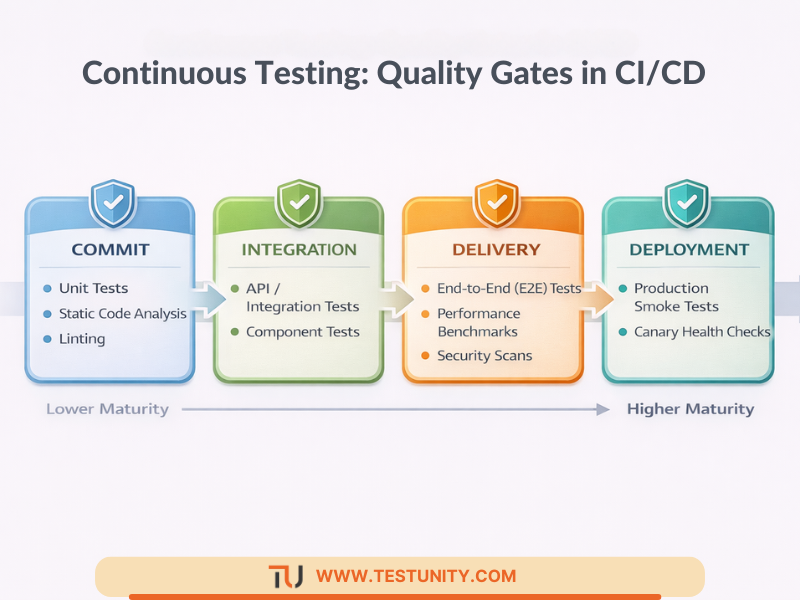
Continuous Testing in CI/CD: The strategy defines the “quality gates” in the pipeline:
-
Commit Stage: Unit tests, static code analysis, linting.
-
Integration Stage: API/integration tests, component tests.
-
Delivery Stage: End-to-end tests on a production-like environment, performance benchmarks, security scans.
-
Deployment Stage: Smoke tests on production, canary health checks.
-
-
Shift-Right & Production Feedback: The strategy incorporates monitoring and observability (logs, metrics, traces) as a first-class test feedback source. It defines practices for synthetic monitoring, bug-bash programs, and learning from production telemetry to refine pre-release testing.
Part III: Quantitative Governance & Strategic Metrics
A PhD-level testing strategy is governed by data, not intuition. It employs a balanced scorecard of metrics that reflect effectiveness, efficiency, and business impact.
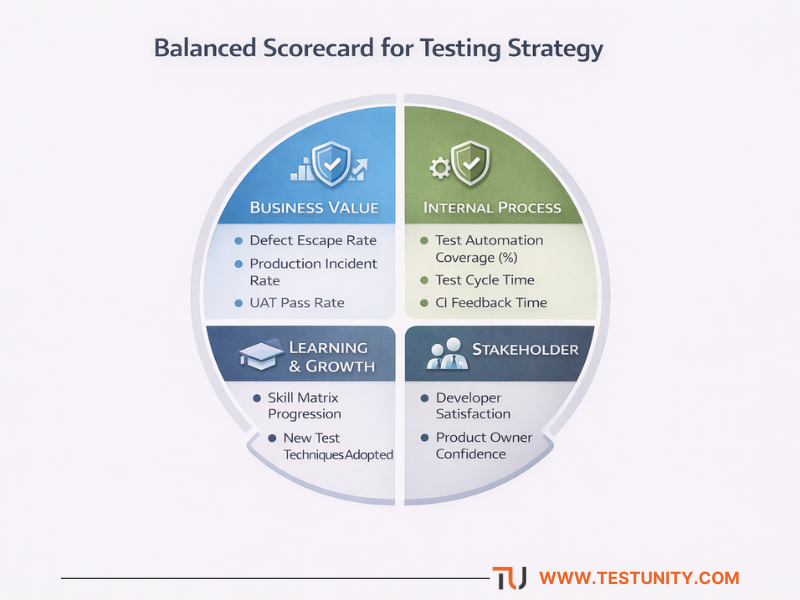
The Testing Strategy Balanced Scorecard:
| Perspective | Sample Metrics | Strategic Purpose |
|---|---|---|
| Business Value | Defect Escape Rate, Production Incident Rate linked to test gaps, UAT pass rate. | Measures how well the strategy protects the business from quality failures. |
| Internal Process | Test Automation Coverage (%) for unit, API, E2E; Test Cycle Time; CI Feedback Time. | Measures the efficiency and speed of the testing machinery. |
| Learning & Growth | Skill matrix progression, innovation in test techniques/tools adopted. | Measures the evolution of testing capability and adaptation. |
| Stakeholder | Developer satisfaction with test feedback, product owner confidence in release readiness. | Measures the perceived value and health of cross-functional collaboration. |
Advanced Analytical Techniques:
-
Predictive Analysis: Use historical data (code churn, complexity, past defects) to build models predicting modules with high defect probability, directing exploratory and automated testing efforts.
-
Test Optimization: Employ algorithms (e.g., genetic algorithms) to optimize large regression suites for maximum risk coverage within a minimum execution time window.
Part IV: Case Study Synthesis & Strategy Formulation Exercise
Scenario: Building a Testing Strategy for a Microservices-Based Fintech Platform.
-
Business Context: High regulatory scrutiny (FINRA, PCI-DSS), extreme requirement for availability and data integrity, complex integration with banking networks.
-
Derived Strategic Emphasis:
-
Security & Compliance First: Mandate SAST/DAST in CI; quarterly external pen testing; automated compliance checks for data handling.
-
Resilience & Performance Core: Implement chaos engineering strategy for service mesh; rigorous performance, load, and endurance testing for each service and the aggregate platform.
-
Integration Depth Over UI Breadth: Prioritize contract testing (Pact), consumer-driven contracts, and sophisticated API integration testing over comprehensive GUI automation.
-
Data Integrity as a Test Target: Design specific tests for idempotency, eventual consistency in sagas, and financial transaction audit trails.
-
-
Toolchain & Governance: Select tools for distributed tracing (Jaeger) and monitoring (Prometheus/Grafana) as integral to the test feedback loop. Define stringent release gates based on resilience test results.
Conclusion: The Strategy as a Living Organism
A premier testing strategy is never a static document to be filed away. It is a living, breathing organism that must be continuously fed by data, challenged by new technologies (AI in testing, shift-left security), and adapted to evolving business landscapes. It requires executive sponsorship, architectural buy-in, and a culture that views strategic investment in quality not as a cost, but as the most reliable engine for sustainable innovation and market trust.
The journey from a tactical, reactive test group to a strategic quality engineering function is paved with deliberate choices framed by a robust testing strategy. It is the single most important determinant of an organization’s ability to deliver software with speed, confidence, and resilience.
Is your organization’s testing strategy a competitive advantage or a hidden liability? TestUnity’s strategic consulting services are designed for engineering leaders. We conduct deep-dive testing strategy audits, facilitate executive workshops to align quality with business goals, and help you build and implement a doctoral-grade, actionable testing strategy framework tailored to your unique challenges.
Ready to architect your quality future? Schedule a strategic advisory session with a TestUnity Fellow to deconstruct your current approach and build a world-class testing strategy.
Read our detailed blog on complete guide to types of software testing, levels and methods.

TestUnity is a leading software testing company dedicated to delivering exceptional quality assurance services to businesses worldwide. With a focus on innovation and excellence, we specialize in functional, automation, performance, and cybersecurity testing. Our expertise spans across industries, ensuring your applications are secure, reliable, and user-friendly. At TestUnity, we leverage the latest tools and methodologies, including AI-driven testing and accessibility compliance, to help you achieve seamless software delivery. Partner with us to stay ahead in the dynamic world of technology with tailored QA solutions.









Leave a Reply