

The Critical Role of Integration Testing in Modern Software Development
In the intricate tapestry of software engineering, where systems evolve from simple monoliths to complex distributed architectures, integration testing emerges as the essential discipline that ensures disparate components unite into a harmonious, functioning whole. While unit testing validates individual pieces and system testing verifies complete behavior, integration testing occupies the crucial middle ground—the domain of interfaces, contracts, and interactions that determine whether software systems succeed or fail.
The evolution from monolithic applications to microservices, serverless functions, and cloud-native architectures has elevated integration testing from a technical formality to a strategic imperative. In today’s interconnected digital ecosystem, where applications communicate across APIs, message queues, and service boundaries, the quality of integration often determines the quality of the entire system.
Understanding the Fundamental Principles
Integration testing represents the systematic verification that two or more software modules exchange data correctly and maintain functional behavior when combined. The fundamental question it answers is: “When individual components work correctly in isolation, do they continue to work correctly when combined?”
The necessity for integration testing stems from several software engineering realities that every development team encounters:
- Assumption Violations: Developers inevitably make implicit assumptions about how other components will behave
- Interface Complexity: Simple interfaces can exhibit complex emergent behaviors when connected
- Environmental Differences: Components may behave differently in integrated environments than in isolation
- Data Transformation Errors: Data format conversions during transmission introduce subtle defects that unit testing cannot catch
Consider a payment processing system where the payment gateway, fraud detection service, and accounting module each pass their unit tests flawlessly. Only through integration testing can you discover that the fraud service expects timestamps in UTC while the accounting system uses local time, causing reconciliation failures during daylight saving transitions.
Comprehensive Methodology Landscape
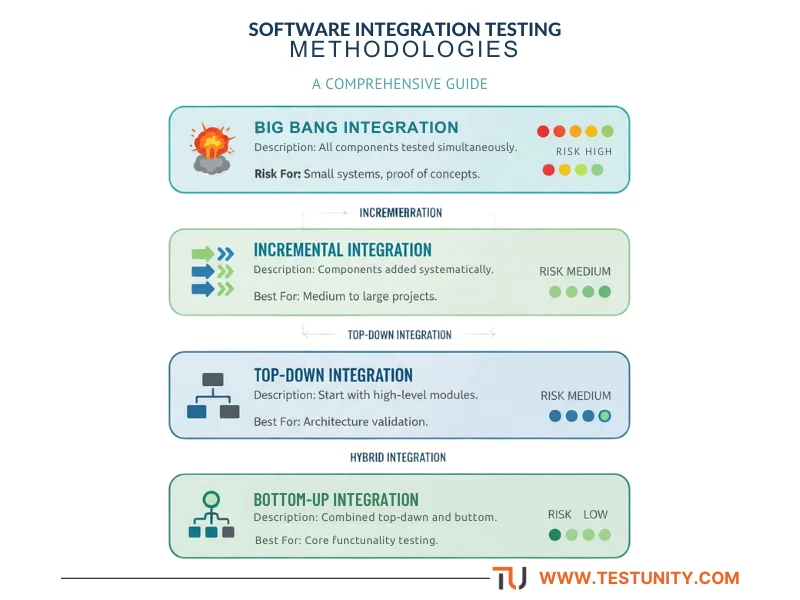
Big Bang Integration: The High-Risk Approach
The Big Bang approach integrates all components simultaneously and tests the complete system. While this method seems straightforward, it carries significant risks that make it unsuitable for most modern applications.
When Big Bang Makes Sense:
- Small systems with fewer than five components
- Legacy system migrations where components are tightly coupled
- Proof-of-concept demonstrations requiring end-to-end validation
Real-World Challenge:
A financial institution migrating a legacy mainframe system used Big Bang integration due to tight coupling between components. While this approach validated system-wide behavior quickly, debugging required sophisticated logging across 50+ integrated modules, turning defect isolation into a week-long investigation for each issue.
Incremental Integration: The Systematic Alternative
Incremental integration adds components systematically, testing interfaces as each new component joins the system. This method provides early feedback and easier defect isolation.
Implementation Strategy:
text
// Example: Progressive integration testing approach
public class OrderProcessingIntegrationTest {
@Test
public void testInventoryToOrderIntegration() {
// First phase: Inventory + Order modules
InventoryService inventory = new RealInventoryService();
OrderService order = new RealOrderService();
OrderProcessor processor = new OrderProcessor(inventory, order);
assertTrue(processor.processOrder(sampleOrder));
}
@Test
public void testPaymentIntegration() {
// Second phase: Add payment processing
PaymentService payment = new RealPaymentService();
OrderProcessor processor = createIntegratedProcessor(payment);
assertTrue(processor.processPayment(sampleOrder));
}
}
Top-Down vs. Bottom-Up: Architectural Considerations
Top-Down Integration begins with high-level modules, using stubs to simulate lower-level components. This approach validates architectural decisions early but delays testing of fundamental utilities.
Bottom-Up Integration starts with foundational components, using drivers to simulate higher-level modules. This method ensures core functionality is solid but may delay discovery of architectural flaws.
The Hybrid Approach combines both strategies, testing from architectural midpoints outward. This balanced method provides early validation of both architecture and core functionality.
Advanced Strategies for Modern Architectures
Microservices Integration Testing
Microservices architectures introduce unique challenges due to distributed ownership and network dependencies. Effective integration testing in these environments requires specialized approaches:
Contract Testing ensures services adhere to published APIs without requiring full deployment. Tools like Pact facilitate consumer-driven contract testing that validates agreements between service providers and consumers.
Service Mesh Testing validates communication through service mesh layers like Istio or Linkerd. This includes testing retry policies, circuit breakers, and traffic routing rules that are critical for system resilience.
Data Consistency Validation verifies eventual consistency across service boundaries. This is particularly crucial for distributed transactions and event-sourced systems where data coherence cannot be assumed.
API-First Integration Testing
In API-driven architectures, integration testing focuses heavily on API contracts and behaviors across multiple dimensions:
Contract Validation verifies request/response formats against OpenAPI or GraphQL specifications. Automated tools can generate tests directly from API specifications, ensuring continuous compliance.
Behavior Testing confirms functional correctness through API interactions. This includes testing happy paths, error conditions, edge cases, and boundary conditions across all integrated endpoints.
Security Integration Testing validates authentication, authorization, and data protection across service boundaries. This includes testing token validation, API keys, and encryption standards between components.
Our specialized API automation testing services employ sophisticated contract testing frameworks that automatically validate API specifications against implementation behavior, catching integration issues before they reach production.
Event-Driven Architecture Testing
Event-driven systems require specialized approaches to verify event flows and processing across component boundaries:
Event Sourcing Tests replay event streams to validate system state reconstruction, ensuring that all components interpret event history consistently.
Message Broker Testing verifies message routing, delivery guarantees, and persistence configurations across Kafka, RabbitMQ, or other messaging platforms.
Process Flow Validation ensures end-to-end business processes work correctly across event boundaries, testing both normal flows and compensation logic for failure scenarios.
Practical Implementation Framework
Test Environment Management
Effective integration testing requires carefully managed environments that balance realism with practicality:
Containerized Testing using Docker and Kubernetes provides consistent, isolated environments that mirror production without the cost and complexity of full staging environments.
Service Virtualization enables testing when dependent systems are unavailable or unstable. Tools like WireMock and Mountebank simulate external dependencies with configurable behaviors and response times.
Data Management Strategy ensures test data consistency across integrated components. This includes:
- Realistic, representative data sets
- Automated data setup and teardown
- Sensitive data masking and compliance
- Version-controlled database migrations
Automation and Continuous Integration
Modern software delivery demands integration testing practices that support rapid, frequent releases:
Pipeline Integration embeds integration tests within CI/CD workflows, providing immediate feedback on integration issues. Our CI/CD integration services help organizations implement robust automated testing pipelines that catch integration issues early.
Test Execution Optimization prioritizes critical integration paths and implements parallel execution to maintain fast feedback cycles without sacrificing coverage.
Environment-Agnostic Testing ensures tests execute consistently across development, staging, and production-like environments, reducing environment-specific failures.
Performance and Resilience Testing
Integration points often represent system performance bottlenecks and single points of failure:
Endpoint Performance Testing measures response times and throughput for individual integration points, identifying bottlenecks before they impact users.
Concurrent Access Testing verifies behavior under simultaneous access patterns, catching thread safety issues and resource contention problems.
Failure Mode Validation tests system behavior during service unavailability, network partitions, and other failure scenarios. Chaos engineering principles can be applied to intentionally introduce failures and validate resilience mechanisms.
Our performance testing services include specialized integration performance validation that identifies bottlenecks in service communication, database interactions, and external API integrations.
Organizational Excellence and Best Practices
Team Structures and Collaboration
Successful integration testing requires thoughtful organizational design and collaboration patterns:
Cross-Functional Quality Ownership distributes integration testing responsibilities across development teams rather than siloing them with specialized testers.
API Contract Reviews establish formal processes for reviewing and approving interface changes, preventing breaking changes from causing integration failures.
Integration Testing Champions within each team promote best practices, mentor other developers, and maintain testing standards across the organization.
Measurement and Continuous Improvement
Effective integration testing requires quantitative measurement and continuous refinement:
Defect Escape Analysis tracks integration issues discovered in later testing stages or production, identifying gaps in test coverage and effectiveness.
Test Coverage Metrics measure the percentage of interfaces, data flows, and interaction patterns covered by automated tests.
Feedback Cycle Time monitors how quickly integration issues are detected and resolved, optimizing the development feedback loop.
Business Impact Assessment correlates integration testing effectiveness with business metrics like release frequency, production incident rates, and customer satisfaction.
Tooling Ecosystem
A robust tooling ecosystem is essential for scalable integration testing:
API Testing Platforms like Postman and Insomnia provide collaborative environments for designing, testing, and documenting APIs across teams.
Service Virtualization Tools like WireMock and Hoverfly simulate external dependencies with realistic behavior and performance characteristics.
Contract Testing Frameworks like Pact and Spring Cloud Contract validate agreements between service consumers and providers.
Monitoring and Observability tools like distributed tracing and structured logging provide visibility into integration points during test execution and production operation.
Emerging Trends and Future Directions
AI-Enhanced Integration Testing
Artificial intelligence is transforming integration testing through advanced capabilities:
Intelligent Test Generation automatically creates test scenarios based on system analysis, API specifications, and historical defect data.
Anomaly Detection identifies unusual integration patterns that may indicate subtle defects or performance degradation.
Predictive Analysis forecasts integration risks based on code change patterns, team velocity, and historical quality metrics.
Shift-Right Testing Practices
Production Integration Validation uses canary deployments, feature flags, and dark launches to test integrated components in production environments with minimal risk.
Real User Monitoring correlates integration performance with actual user experience, providing real-world validation of integration quality.
Continuous Feedback Loops connect production monitoring with test automation, automatically generating tests based on observed usage patterns and failure modes.
Blockchain and Distributed Systems
Emerging technologies introduce new integration paradigms that require specialized testing approaches:
Smart Contract Integration validates business logic execution across distributed blockchain nodes with consensus mechanisms.
Cryptographic Verification tests security implementations, key management, and digital signature validation across integrated components.
Decentralized Data Consistency ensures data coherence across distributed ledgers and traditional databases.
Building a Sustainable Integration Testing Practice

Strategic Implementation Roadmap
Developing an effective integration testing strategy requires systematic planning and phased implementation:
Phase 1: Foundation Establishment
- Identify critical integration points and data flows
- Implement basic automation and environment management
- Establish coding standards for integration test development
- Train teams on fundamental concepts and tools
Phase 2: Expansion and Scaling
- Broaden test coverage to include all major integration paths
- Implement continuous testing in CI/CD pipelines
- Develop specialized skills for microservices and API testing
- Establish metrics and monitoring for continuous improvement
Phase 3: Optimization and Innovation
- Implement AI-assisted test generation and optimization
- Develop advanced resilience and performance testing
- Establish organizational excellence through communities of practice
- Continuously refine processes based on metrics and feedback
Cultural Enablers for Success
Technical implementation alone cannot guarantee integration testing success. The most effective organizations cultivate:
Quality Ownership Culture where every team member takes responsibility for integration quality, not just specialized testers.
Continuous Learning Mindset with regular reflection, knowledge sharing, and process improvement based on both successes and failures.
Collaborative Communication that breaks down silos between teams, ensuring everyone understands integration dependencies and constraints.
Psychological Safety that encourages team members to identify integration risks early without fear of blame or criticism.
Conclusion: Integration Testing as Engineering Discipline
Integration testing has evolved from a tactical verification activity to a strategic engineering discipline essential for building reliable, maintainable software systems. In an era of distributed architectures, microservices, and continuous delivery, the ability to validate component interactions systematically separates successful engineering organizations from their struggling counterparts.
The organizations that master integration testing as an engineering discipline position themselves to deliver higher-quality software faster, with greater confidence and reduced risk. The investment in comprehensive integration testing capabilities yields substantial returns in system reliability, development efficiency, and ultimately, business outcomes.
As systems continue growing in complexity and delivery cadences accelerate, integration testing will increasingly become the linchpin that enables organizations to innovate rapidly without sacrificing quality or stability. The future belongs to teams that treat integration not as an afterthought, but as a first-class engineering concern worthy of careful design, implementation, and continuous improvement.
Professional Integration Testing Services
Elevate Your Integration Testing Capabilities
Building world-class integration testing practices requires specialized expertise, sophisticated tools, and proven methodologies. TestUnity‘s integration testing experts bring decades of cumulative experience across diverse industries and technology stacks.
Our Comprehensive Service Offerings
- Integration Testing Strategy Development: Customized approaches aligned with your architecture and business objectives
- Test Automation Framework Implementation: Robust, maintainable test automation infrastructure
- API and Microservices Testing: Specialized validation for modern distributed systems
- Legacy System Integration Testing: Strategies for complex, established systems
- Continuous Testing Pipeline Integration: Seamless incorporation into DevOps workflows
Strategic Partnership Benefits
- Reduced Time-to-Market: Accelerated delivery through efficient testing processes
- Enhanced System Reliability: Fewer production incidents and service disruptions
- Optimized Resource Utilization: Focused testing efforts on critical risk areas
- Knowledge Transfer: Sustainable internal capabilities through mentoring and training
Connect with Our Experts
Schedule a complimentary integration testing assessment to identify improvement opportunities in your current approach. Our technical leaders will analyze your architecture, processes, and objectives to provide actionable recommendations for enhancing your integration testing effectiveness.
Explore our comprehensive testing resources:
- Deepen your understanding of all types of software testing through our detailed guide
- Discover specialized approaches in our performance testing tools and best practices guide
- Visit TestUnity.com for complete service offerings and case studies
- Explore TestUnity.ae for specialized Middle East region services
Contact us today to transform your integration testing from a compliance activity to a strategic advantage that drives business results through superior software quality and reliability.

TestUnity is a leading software testing company dedicated to delivering exceptional quality assurance services to businesses worldwide. With a focus on innovation and excellence, we specialize in functional, automation, performance, and cybersecurity testing. Our expertise spans across industries, ensuring your applications are secure, reliable, and user-friendly. At TestUnity, we leverage the latest tools and methodologies, including AI-driven testing and accessibility compliance, to help you achieve seamless software delivery. Partner with us to stay ahead in the dynamic world of technology with tailored QA solutions.



Great line up. We will be linking to this great article on our site. Keep up the good writing.
it will be really helpful. we truely appreciate it.
Excellent overview
thanks
Your writing is so eloquent and engaging You have a gift for connecting with your readers and making us feel understood
Thank you so much for your kind words! I’m thrilled to hear that you find the writing eloquent and engaging. Connecting with readers and making them feel understood is truly the goal. If there are any specific topics or questions you’d like to explore further, please don’t hesitate to share! Your feedback means a lot!