

The fundamental distinction between black box vs white box testing represents one of the most critical decisions in software quality assurance strategy. These two contrasting methodologies—one examining internal code structures and the other evaluating external behavior—form the foundation upon which comprehensive testing programs are built. Understanding when and how to apply each approach, or more importantly, how to integrate them effectively, separates basic testing efforts from sophisticated quality assurance programs that deliver measurable business value.
The choice between black box vs white box testing isn’t merely technical; it’s strategic, impacting everything from development velocity and defect detection rates to resource allocation and team skills development. This comprehensive guide explores both methodologies in depth, providing practical insights for choosing and implementing the right approach for your specific context.
Understanding the Fundamental Distinction
The Black Box Perspective
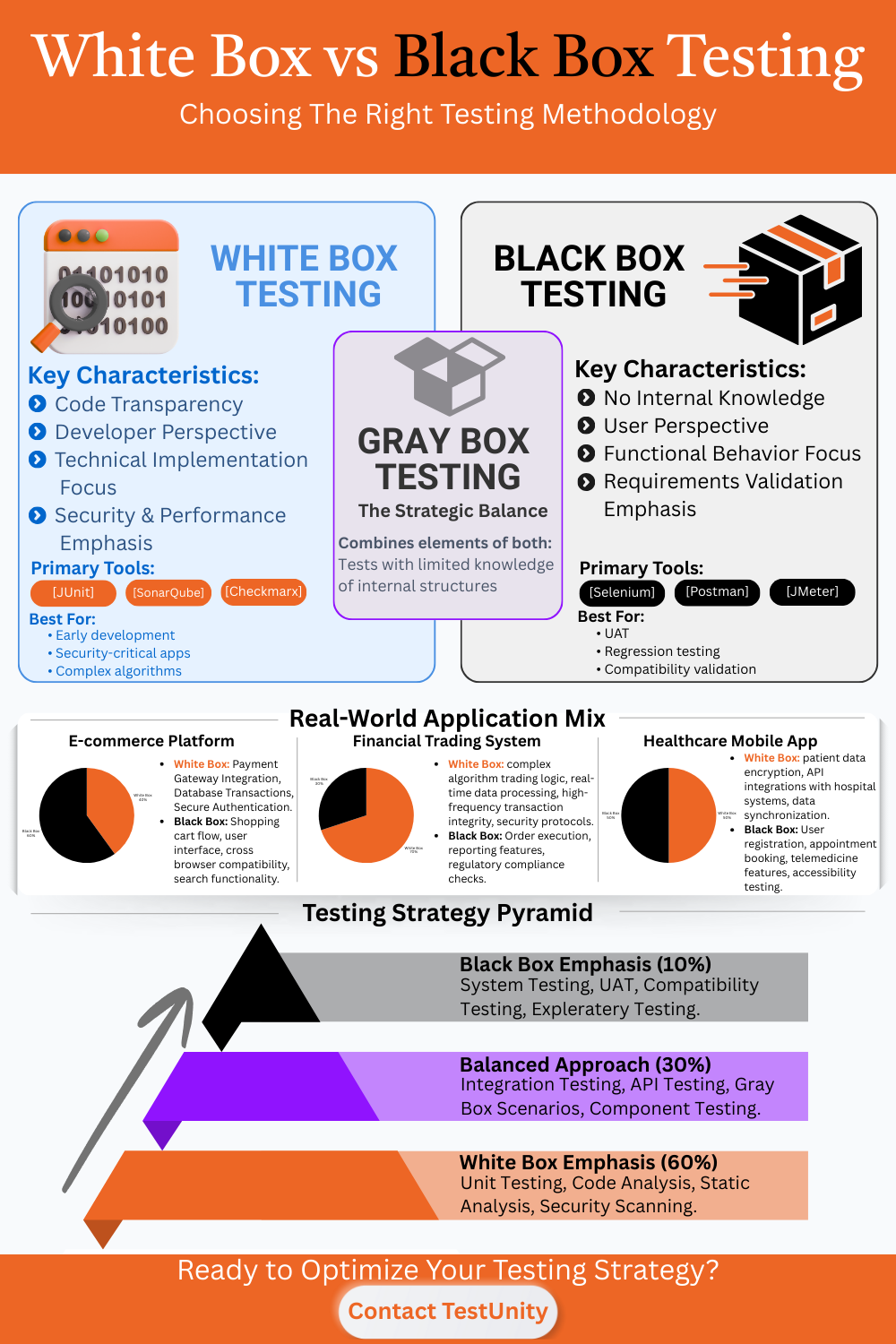
Black box testing operates on the principle of testing software without knowledge of its internal workings, architecture, or implementation details. Testers approach the application as users would, focusing solely on inputs and outputs, functionality, and user experience. This methodology is analogous to testing a physical black box—you can observe what goes in and what comes out, but you cannot see or understand the internal mechanisms.
The strength of black box testing lies in its ability to validate that software meets specified requirements and delivers expected functionality from the user’s perspective. It’s particularly valuable for identifying integration issues, usability problems, and requirements gaps that might be overlooked when focusing too closely on implementation details.
The White Box Perspective
White box testing (also known as clear box, glass box, or structural testing) involves testing software with full knowledge of its internal code structure, implementation details, and architectural decisions. Testers examine the actual code, data flow, and internal logic to identify potential issues that might not manifest in observable external behavior.
This approach is particularly effective for identifying specific types of defects including logic errors, security vulnerabilities, performance bottlenecks, and code quality issues that remain hidden from external observation. White box testing requires technical expertise but offers insights that significantly enhance overall software quality.
Deep Dive: Black Box Testing Methodology
Core Principles and Characteristics
Black box testing operates on several foundational principles:
Requirement-Based Validation: Tests are derived from functional specifications, requirements documents, and user stories rather than implementation details.
User Perspective Focus: Testing emulates real user interactions, workflows, and usage patterns.
Internal Logic Independence: Testers don’t need programming knowledge or access to source code.
Boundary Value Analysis: Systematic testing of input boundaries, extremes, and edge cases.
Equivalence Partitioning: Grouping inputs that should produce similar outputs to reduce test cases while maintaining coverage.
Key Black Box Testing Techniques
Several specialized techniques enhance black box testing effectiveness:
Functional Testing: Validating that all specified functions work correctly according to requirements.
Regression Testing: Ensuring existing functionality remains intact after changes or updates.
User Acceptance Testing (UAT): Final validation by business stakeholders that requirements are met.
Compatibility Testing: Verifying consistent behavior across different browsers, devices, and platforms.
Usability Testing: Evaluating user interface intuitiveness, workflow efficiency, and overall user experience.
Performance Testing: Assessing application responsiveness, stability, and scalability under various conditions.
For comprehensive functional testing strategies, our approach ensures thorough validation of all business requirements and user workflows.
Advantages of Black Box Testing
Black box testing offers several compelling benefits:
User-Centric Validation: Ensures software meets actual user needs and expectations.
Non-Technical Tester Accessibility: Doesn’t require programming expertise, broadening the testing talent pool.
Early Requirements Validation: Identifies ambiguous, incomplete, or contradictory requirements during test design.
Unbiased Testing Perspective: Testers aren’t influenced by implementation decisions or developer assumptions.
Integration Focus: Naturally identifies issues at component and system integration points.
Real-World Scenario Testing: Effectively tests complete user journeys and business processes.
Limitations and Challenges
Despite its strengths, black box testing has notable limitations:
Limited Code Coverage: Cannot ensure all code paths and conditions are tested.
Potential Redundancy: May test the same functionality multiple times through different user paths.
Late Defect Detection: Some issues might only be detectable after complete feature implementation.
Resource Intensity: Comprehensive scenario testing can require significant time and effort.
Dependency on Specifications: Effectiveness depends heavily on quality and completeness of requirements.
Deep Dive: White Box Testing Methodology
Core Principles and Characteristics
White box testing follows distinct principles that complement black box approaches:
Code Structure Analysis: Testing focuses on internal logic, control flow, and data flow within the application.
Implementation Knowledge: Testers require programming skills and understanding of software architecture.
Path Coverage Goals: Aiming to test all possible execution paths through the code.
Internal Quality Assessment: Evaluating code quality, maintainability, and adherence to standards.
Security Vulnerability Identification: Detecting potential security issues at the code level.
Key White Box Testing Techniques
Specialized techniques maximize white box testing effectiveness:
Unit Testing: Testing individual components or functions in isolation from the rest of the system. Our comprehensive guide to unit testing provides detailed strategies for effective component validation.
Static Code Analysis: Examining source code without execution to identify potential issues.
Code Review: Systematic examination of source code by peers to identify defects and improve quality.
Mutation Testing: Introducing small changes (mutations) to code to evaluate test effectiveness.
Control Flow Testing: Validating all possible paths through decision points in the code.
Data Flow Testing: Tracking variable usage from definition to use to identify potential issues.
Advantages of White Box Testing
White box testing delivers unique benefits that complement black box approaches:
Comprehensive Code Coverage: Can validate all code paths, branches, and conditions.
Early Defect Detection: Identifies issues during development when they’re cheapest to fix.
Optimization Opportunities: Reveals performance bottlenecks and optimization possibilities.
Security Enhancement: Identifies vulnerabilities that might not manifest in functional testing.
Code Quality Improvement: Encourages better coding practices and architectural decisions.
Precise Defect Localization: When tests fail, the specific problematic code section is clearly identified.
Limitations and Challenges
White box testing also presents specific challenges:
Technical Expertise Requirements: Testers need strong programming and system architecture knowledge.
Implementation Bias: Testers might unconsciously avoid testing paths they know are problematic.
Time Intensive: Comprehensive path testing can require significant development time.
Potential Over-Engineering: Risk of focusing too much on internal quality at the expense of user experience.
Limited Business Perspective: Might miss requirements gaps or user experience issues.
Comparative Analysis: White Box vs Black Box
Direct Comparison Framework
Understanding when to apply each methodology requires clear comparison:
Knowledge Requirement:
-
White Box: Requires internal code and architecture knowledge
-
Black Box: No internal knowledge required
Tester Perspective:
-
White Box: Developer/internal perspective
-
Black Box: End-user/external perspective
Testing Focus:
-
White Box: How the system works internally
-
Black Box: What the system does functionally
Primary Objectives:
-
White Box: Code quality, security, performance optimization
-
Black Box: Requirements validation, user experience, integration
Ideal Timing:
-
White Box: During development and component completion
-
Black Box: After feature completion and during integration
Skill Requirements:
-
White Box: Programming, debugging, architecture knowledge
-
Black Box: Domain knowledge, user perspective, requirements analysis
Defect Types Found:
-
White Box: Logic errors, security flaws, performance issues
-
Black Box: Missing functionality, usability issues, integration problems
Complementary Nature
The most effective testing strategies recognize that white box vs black box isn’t an either/or decision but rather a strategic balance:
Defect Prevention vs Detection: White box prevents defects through code quality, while black box detects functional issues.
Technical vs Business Focus: White box addresses technical implementation, black box addresses business requirements.
Component vs System Level: White box excels at component validation, black box at system integration.
Early vs Late Cycle: White box integrates throughout development, black box typically occurs later.
Gray Box Testing: The Integrated Approach
Bridging the Methodology Gap
Gray box testing represents the practical integration of both methodologies, combining internal knowledge with external testing perspectives:
Partial Knowledge Approach: Testers have some knowledge of internal structures but focus on external behavior.
Integration Focus: Particularly effective for testing component interactions and integration points.
Efficiency Balance: Leverages internal knowledge to design more effective black box tests.
Real-World Pragmatism: Reflects how most experienced testers actually work in practice.
Gray Box Testing Applications
Specific scenarios where gray box testing excels:
API Testing: Understanding internal data structures while testing external interfaces.
Database Testing: Knowing schema design while validating data operations.
Security Testing: Understanding potential vulnerabilities while testing external security controls.
Performance Testing: Knowing internal architecture while measuring external performance metrics.
Strategic Implementation Framework
Choosing the Right Mix
The optimal balance between black box vs white box testing depends on multiple factors:
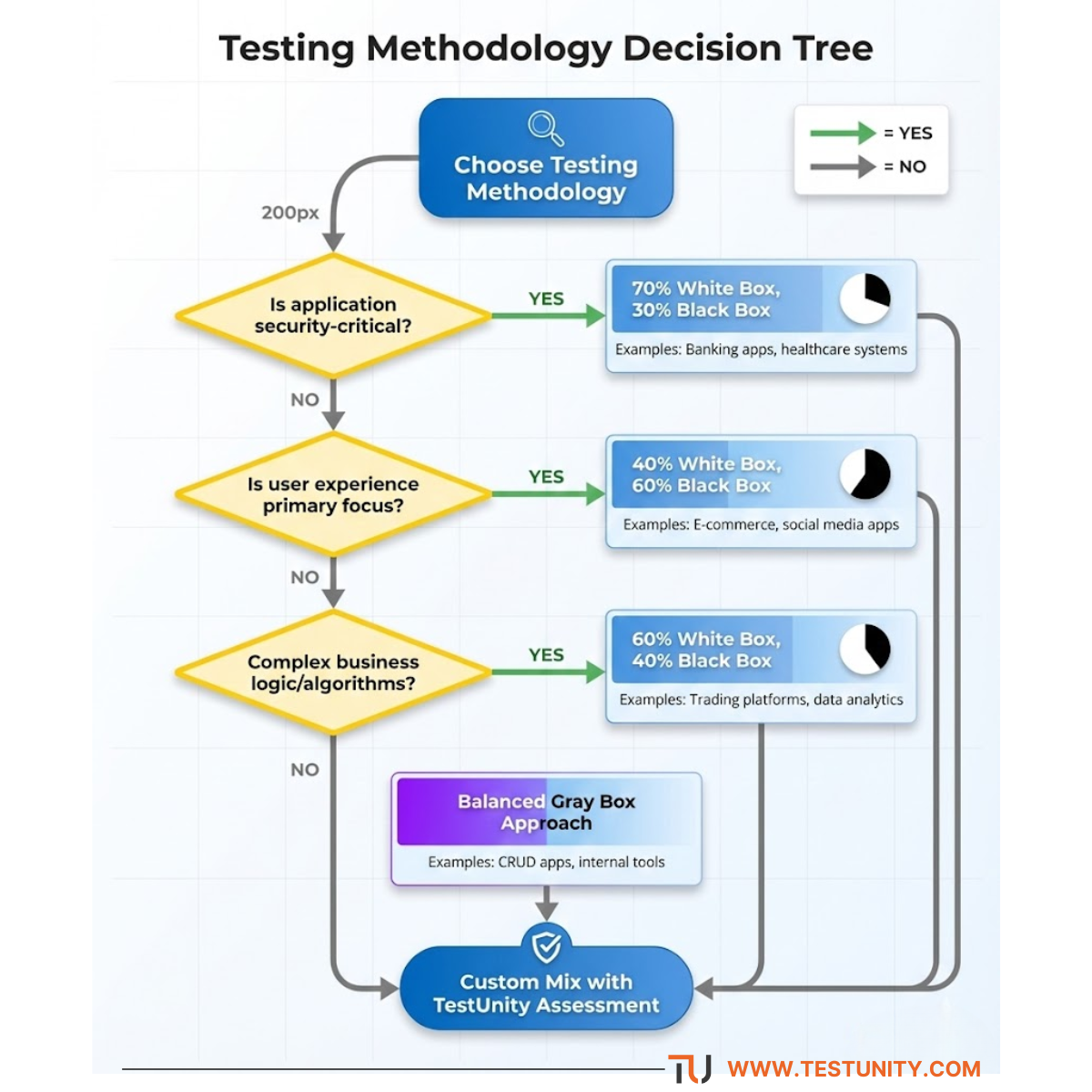
Project Type and Complexity:
-
Simple CRUD applications: Heavier black box emphasis
-
Complex algorithms/systems: Significant white box emphasis
-
Safety-critical systems: Extensive white box with complementary black box
Development Methodology:
-
Waterfall: Sequential application with distinct phases
-
Agile/DevOps: Integrated, continuous testing throughout
-
Test-Driven Development: White box emphasis during development
Team Composition and Skills:
-
Developer-heavy teams: Natural white box capability
-
Dedicated QA teams: Stronger black box orientation
-
Cross-functional teams: Opportunity for balanced approach
Risk Profile and Criticality:
-
High-risk applications: Comprehensive white box for reliability
-
User-facing applications: Extensive black box for experience
-
Regulatory requirements: Specific methodology mandates
Implementation Roadmap
A phased approach to implementing balanced testing:
Phase 1: Assessment and Planning
-
Analyze application architecture and risk profile
-
Assess team skills and capabilities
-
Define testing objectives and success metrics
-
Establish methodology balance targets
Phase 2: Foundation Building
-
Implement core unit testing (white box foundation)
-
Establish basic functional testing (black box foundation)
-
Create test environment and data strategies
-
Develop initial test suites for critical paths
Phase 3: Expansion and Integration
-
Expand test coverage across both methodologies
-
Integrate testing into development workflows
-
Implement automation for repetitive tests
-
Establish continuous testing practices
Phase 4: Optimization and Maturation
-
Refine methodology balance based on results
-
Implement advanced testing techniques
-
Integrate with broader quality initiatives
-
Establish metrics-driven improvement cycles
Real-World Application Scenarios
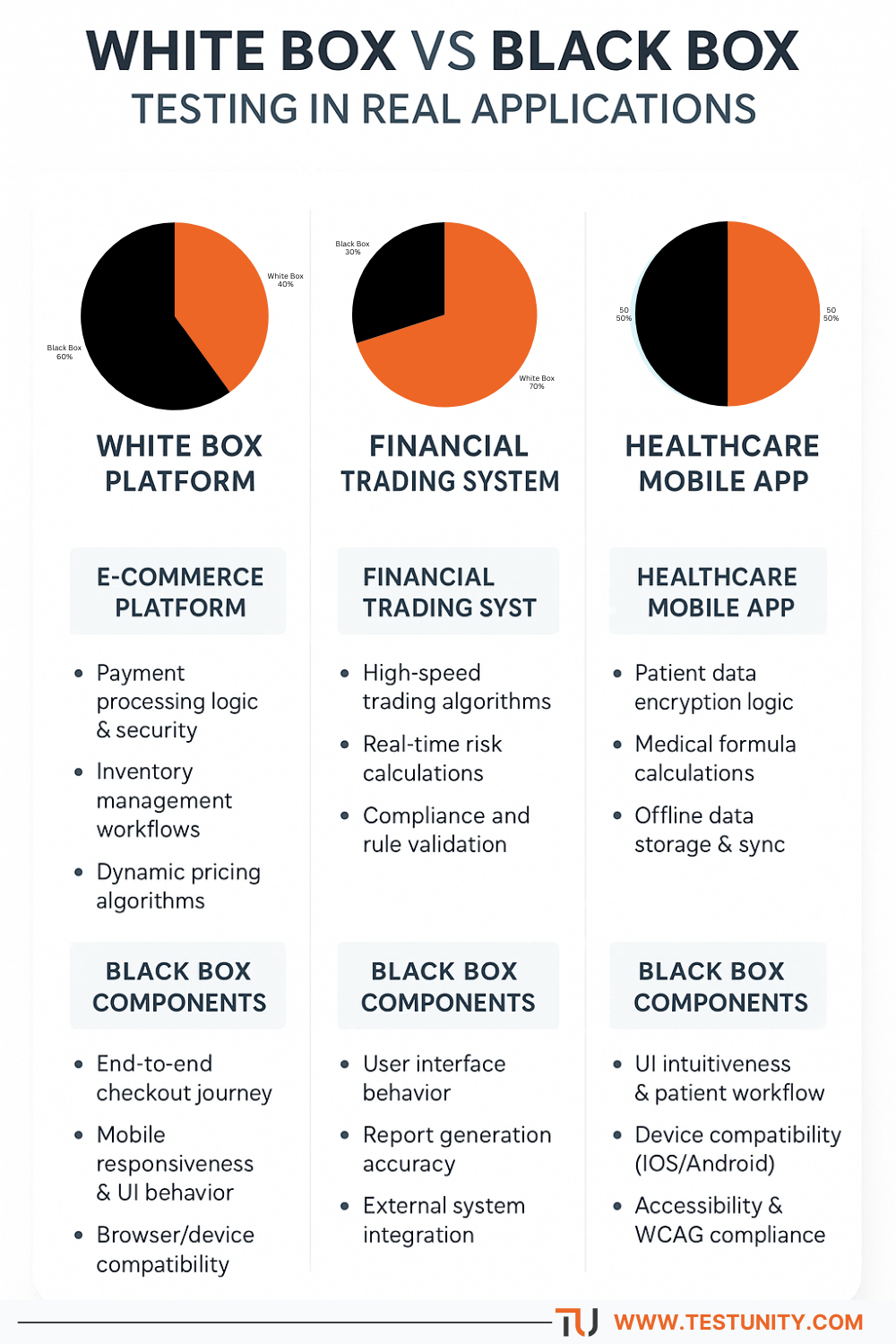
E-commerce Platform Example
Recommended Approach: 40% White Box, 60% Black Box
White Box Components:
-
Payment processing algorithms and security
-
Inventory management logic
-
Pricing calculation engines
-
Order processing workflows
Black Box Components:
-
User registration and login flows
-
Product search and filtering
-
Shopping cart functionality
-
Checkout process and user experience
-
Mobile responsiveness and compatibility
Integration Strategy: White box validates business logic correctness, black box ensures seamless user experience across the complete purchase journey.
Financial Trading System Example
Recommended Approach: 70% White Box, 30% Black Box
White Box Components:
-
Trading algorithm implementation
-
Risk calculation engines
-
Compliance rule validation
-
Data processing pipelines
-
Security implementation
Black Box Components:
-
User interface functionality
-
Report generation and export
-
System integration points
-
Performance under load
Integration Strategy: Extensive white box testing ensures mathematical correctness and regulatory compliance, complemented by black box validation of user functionality and integration stability.
Healthcare Mobile Application Example
Recommended Approach: 50% White Box, 50% Black Box
White Box Components:
-
Patient data encryption and security
-
Medical calculation algorithms
-
Data synchronization logic
-
Offline functionality implementation
Black Box Components:
-
User interface intuitiveness
-
Cross-device compatibility
-
Notification system reliability
-
Integration with healthcare systems
-
Accessibility compliance
Integration Strategy: White box ensures data security and medical accuracy, black box validates patient usability and cross-platform reliability.
Integrating with Comprehensive Testing Strategy
Test Pyramid Alignment
Both methodologies fit within the broader testing strategy:
Foundation Layer (White Box Emphasis):
-
Unit testing of individual components
-
Static code analysis
-
Code review processes
Integration Layer (Balanced Approach):
-
API and service integration testing
-
Database and data layer testing
-
Component interaction validation
System Layer (Black Box Emphasis):
-
End-to-end workflow testing
-
User acceptance testing
-
Performance and load testing
-
Compatibility and usability testing
Our guide to system testing provides additional insights into comprehensive application validation strategies.
Development Lifecycle Integration
Effective methodology integration throughout development:
Requirements Phase:
-
Black box: Test scenario design based on requirements
-
White box: Technical feasibility and testability assessment
Design Phase:
-
White box: Testability considerations in architecture
-
Black box: User journey mapping and scenario refinement
Development Phase:
-
White box: Unit testing, code review, static analysis
-
Black box: Early feature validation and usability feedback
Testing Phase:
-
White box: Security testing, performance optimization
-
Black box: Functional testing, integration validation
Deployment Phase:
-
Black box: User acceptance testing, production validation
-
White box: Performance monitoring, log analysis
Tools and Technologies
White Box Testing Tools
Specialized tools for structural testing:
Unit Testing Frameworks: JUnit, NUnit, pytest, Mocha
Static Analysis Tools: SonarQube, Checkmarx, Fortify
Code Coverage Tools: JaCoCo, Istanbul, Coverlet
Performance Profilers: VisualVM, dotTrace, Xcode Instruments
Black Box Testing Tools
Tools for functional and behavioral testing:
Test Automation Frameworks: Selenium, Cypress, Playwright
API Testing Tools: Postman, SoapUI, RestAssured
Performance Testing Tools: JMeter, LoadRunner, Gatling
Exploratory Testing Support: Session-based testing tools
Integrated Testing Platforms
Tools supporting both methodologies:
CI/CD Platforms: Jenkins, GitLab CI, GitHub Actions
Test Management Systems: TestRail, qTest, Zephyr
Monitoring and Analytics: Datadog, New Relic, AppDynamics
Cloud Testing Services: TestUnity, BrowserStack, Sauce Labs, AWS Device Farm
Measuring Effectiveness and ROI
Methodology-Specific Metrics
White Box Metrics:
-
Code coverage percentage (line, branch, path)
-
Static analysis violation counts and trends
-
Defect density by code module
-
Technical debt quantification
Black Box Metrics:
-
Requirements coverage percentage
-
Defect detection effectiveness
-
Test case effectiveness ratio
-
User satisfaction scores
Integrated Quality Metrics
Combined Effectiveness Measures:
-
Defect escape rate to production
-
Mean time to detect and resolve defects
-
Testing efficiency (defects found per test hour)
-
Overall application quality index
Business Impact Metrics:
-
Reduction in production incidents
-
Improvement in user satisfaction
-
Acceleration of release cycles
-
Reduction in support and maintenance costs
Future Trends and Evolution
AI and Machine Learning Impact
Emerging technologies transforming both methodologies:
AI-Enhanced White Box Testing:
-
Intelligent code analysis and defect prediction
-
Automated test generation from code analysis
-
Self-healing tests that adapt to code changes
-
Predictive maintenance of test suites
AI-Enhanced Black Box Testing:
-
Intelligent test scenario generation
-
User behavior pattern analysis for test design
-
Automated exploratory testing agents
-
Natural language test creation and execution
Our exploration of AI in software testing examines these emerging trends in detail.
Methodology Convergence Trends
The evolving landscape of black box vs white box testing:
Shift-Left Integration: Earlier black box involvement in development cycles
Developer Testing Empowerment: White box techniques accessible to broader teams
Observability Integration: Production monitoring informing both methodologies
Continuous Testing: Seamless methodology integration in DevOps pipelines
Conclusion: Strategic Balance for Optimal Quality
The decision between black box vs white box testing isn’t about choosing one over the other, but rather about strategically balancing both methodologies to create a comprehensive quality assurance program that addresses all aspects of software quality. The most effective organizations recognize that these approaches complement rather than compete with each other, each addressing different quality dimensions that together ensure software excellence.
White box testing provides the technical foundation, ensuring code quality, security, and performance from the inside out. Black box testing delivers user-centric validation, ensuring functionality, usability, and business value from the outside in. Together, they form a complete quality assurance strategy that prevents defects, detects issues early, and validates that software meets both technical and business requirements.
The optimal balance depends on your specific context: application type, risk profile, team capabilities, and business objectives. What remains constant is the need for both perspectives—the internal view that ensures technical excellence and the external view that validates user value.
As software development continues evolving with new technologies, methodologies, and delivery approaches, the fundamental importance of both white box and black box testing remains. Organizations that master the strategic integration of both approaches will deliver higher quality software, faster, with greater confidence and efficiency.
At TestUnity, we help organizations implement balanced testing strategies that leverage both white box and black box methodologies effectively. Our experience spans technical testing implementation and user-centric validation, enabling us to recommend approaches that address all dimensions of software quality while aligning with business objectives and technical constraints.
Ready to implement a balanced testing strategy that leverages both white box and black box methodologies? Contact TestUnity for a comprehensive testing assessment. Our testing experts can help you design and implement a testing approach that addresses technical quality, user experience, and business requirements, ensuring your software delivers excellence from the inside out and the outside in.
Read our Ddetailed blog on Complete Guide to Types of Software Testing, Levels and Methods

TestUnity is a leading software testing company dedicated to delivering exceptional quality assurance services to businesses worldwide. With a focus on innovation and excellence, we specialize in functional, automation, performance, and cybersecurity testing. Our expertise spans across industries, ensuring your applications are secure, reliable, and user-friendly. At TestUnity, we leverage the latest tools and methodologies, including AI-driven testing and accessibility compliance, to help you achieve seamless software delivery. Partner with us to stay ahead in the dynamic world of technology with tailored QA solutions.









Leave a Reply