
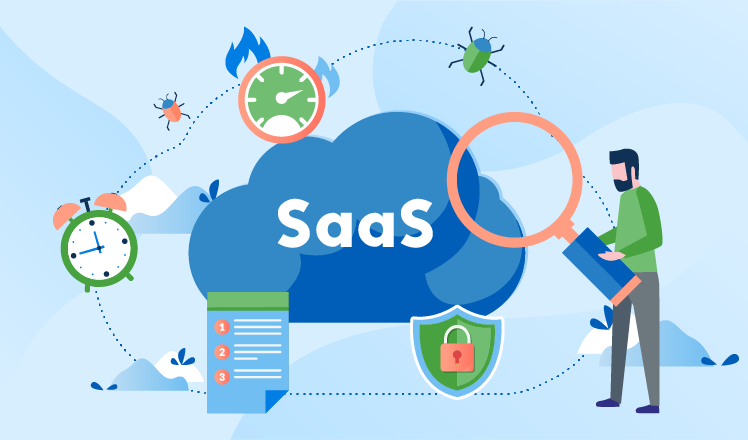
Software‑as‑a‑Service (SaaS) has fundamentally changed how businesses operate. From email services (Gmail, Outlook) and office suites (Office 365, Google Workspace) to CRM platforms (Salesforce, HubSpot) and cloud storage (Dropbox, Box), SaaS applications are now the backbone of modern enterprises. A 2026 report found that the average enterprise SaaS portfolio churns at about 34% annually — meaning rapid adoption, but also constant change. Moreover, a growing share of full‑time workers now expect remote or hybrid work at least three times per week, further accelerating dependence on cloud‑based tools.
But delivering a reliable, secure, and high‑performing SaaS product is far from trivial. Unlike on‑premise software, SaaS operates across complex, distributed environments involving multiple servers, databases, APIs, networks, and client devices — with frequent release cycles and strict compliance demands. This is where rigorous SaaS testing becomes indispensable.
In this comprehensive guide, we cover everything you need to know about testing SaaS applications in 2026: the unique challenges, essential test types, security and compliance considerations, top tools, and how a partner like TestUnity can help you ship quality cloud software with confidence.
Why SaaS Testing Is More Critical Than Ever
SaaS platforms process sensitive business data, handle millions of users simultaneously, and are expected to be available 24/7/365. Any outage — even a 5‑second slowdown — can damage brand reputation, drive customer churn, and incur regulatory penalties.
According to Cloud Security Alliance research, there has been a sharp increase in SaaS security incidents, driven by rising complexity in application ecosystems and new AI‑enabled attack vectors. API attacks surged 104% year‑over‑year, with 13 times more vulnerability exploits compared to traditional websites. A single misconfiguration or tenant isolation flaw can expose thousands of customers’ data simultaneously.
Consequently, testing is no longer a final‑stage gate; it must be continuous, risk‑based, and embedded across the entire development lifecycle.
Key Types of Testing for SaaS Applications
A comprehensive SaaS testing strategy includes the following categories:
1. Functional Testing
Validates end‑to‑end business workflows against requirements. This includes user registration, subscription management, role‑based permissions, data processing, and reporting. Functional tests should cover both positive and negative scenarios (e.g., invalid login attempts, insufficient privileges).
2. Performance & Load Testing
SaaS platforms must remain responsive under varying user loads. Performance testing includes:
- Load testing: Verify behaviour under expected concurrent usage.
- Stress testing: Push beyond capacity to find breaking points.
- Spike testing: Simulate sudden traffic surges.
- Soak (endurance) testing: Long‑duration runs to detect memory leaks or performance degradation.
- Scalability testing: Assess how the system handles increased resources.
3. Security Testing
SaaS security testing has become a top priority due to high‑profile breaches and rising API attacks. Essential areas include:
- Multi‑tenant isolation: Ensure one customer cannot access another’s data (horizontal/vertical privilege escalation).
- API penetration testing: Check for Broken Object‑Level Authorization (BOLA), excessive data exposure, mass assignment, and business logic flaws. Use a combination of automated scanning (DAST) and manual penetration testing.
- Identity & access management (IAM) testing: Validate SSO, MFA, OAuth token handling, and least‑privilege principles. SaaS environments often run on “trust implicitly” models, where tokens rarely expire and permissions are overly broad.
- Data encryption: Confirm data‑at‑rest and in‑transit encryption, key management, and adherence to compliance standards.
4. Compatibility & Cross‑Browser Testing
SaaS products are accessed from diverse devices (Windows, Mac, iOS, Android) and browsers (Chrome, Firefox, Safari, Edge). Use cloud device labs (e.g., BrowserStack, Sauce Labs) to ensure uniform user experience.
Internal Link: For practical tool guidance, see our How to Conduct Cross‑Browser Testing Using Selenium WebDriver.
5. Integration & Interoperability Testing
SaaS apps rarely operate in isolation; they integrate with payment gateways, CRM systems, messaging tools, and third‑party APIs. Validate data flow, error handling, and fallback mechanisms under real‑world conditions.
6. GUI / UI Testing
The front‑end must be intuitive and responsive. GUI testing covers navigation, form inputs, visual consistency, and error messages across resolutions and devices.
7. Continuous Regression Testing
Given frequent releases (sometimes daily), automated regression suites are essential to catch unintended side effects. Prioritize tests based on risk and business impact.
8. Network & Connectivity Testing
Simulate various bandwidth conditions, latency, packet loss, and network transitions (e.g., Wi‑Fi to cellular) to verify that the application remains functional and user‑friendly.
Security and Compliance: Non‑Negotiable Pillars of SaaS Testing
Security Testing in a Zero‑Trust World
The conventional “trust but verify” model fails in the SaaS era, where OAuth tokens and API keys often persist indefinitely. Recent breaches — including the Salesloft / Drift incident — demonstrated how cybercriminals compromise third‑party integrations and steal OAuth tokens, granting broad access to core systems.
Accordingly, modern SaaS testing must include:
- Token expiry and rotation checks.
- Cross‑tenant session replay tests.
- Identity governance reviews to detect over‑provisioned permissions.
- Automated detection of data leakage via Shadow APIs.
Compliance Requirements
SaaS providers and enterprises using SaaS must comply with an expanding set of regulations, including:
| Regulation | Key Requirement | Penalty |
|---|---|---|
| GDPR | Protects personal data of EU residents, requiring data minimization, consent, and breach notification. | Up to €20 million or 4% of global annual revenue. |
| HIPAA | Safeguards protected health information (PHI) with administrative, physical, and technical safeguards. | Civil penalties up to $1.9 million per violation category per year. |
| SOC 2 | Evaluates service organisation controls: security, availability, processing integrity, confidentiality, privacy. | Customer‑driven; failures lead to lost contracts. |
| ISO 27001 | International information security management standard, requiring systematic risk management and continuous improvement. | Loss of certification and market trust. |
| PCI DSS | Applicable if processing, storing, or transmitting cardholder data. | Fines, increased transaction fees, loss of payment processing ability. |
Automated compliance testing — including logging retention, access reviews, and encryption validation — reduces audit burdens and helps avoid costly penalties.
Internal Link: For a deeper look at security testing frameworks, read our Everything You Need to Know About Web Application Penetration Testing.
AI & Emerging Trends in SaaS Testing (2026)
AI is reshaping SaaS quality assurance across multiple dimensions:
- Agentic AI for testing: AI‑driven agents generate test candidates, simulate user journeys, triage failures, and continuously validate critical workflows, reducing manual maintenance. BrowserStack’s 2026 report found that 94% of teams now use AI in testing, but only 12% have reached full autonomy — indicating a growing reliance on AI copilots.
- Shift‑left and shift‑right simultaneously: Modern pipelines integrate static analysis, contract testing, and production monitoring to unify quality across the entire lifecycle.
- Self‑healing automation: AI‑powered tools adapt to UI changes without script rewrites, dramatically reducing maintenance costs.
- Predictive analytics: Machine learning models forecast failure hotspots based on historical defect data and code complexity, enabling proactive risk mitigation.
- AI‑generated test data: Generative AI creates realistic, privacy‑compliant test data at scale, eliminating manual setup overhead.
Internal Link: For more on AI’s role in quality, read our The AI Impact on Software Testing in 2026.
Essential Tools for SaaS Testing
| Tool | Primary Use | Key Feature |
|---|---|---|
| Appium | Mobile app testing | Open‑source, cross‑platform automation for native, hybrid, and mobile web apps. |
| Katalon Studio | End‑to‑end testing (web, mobile, API) | Built‑on Selenium/Appium, with low‑code interface, CI/CD integration. |
| Selenium | Web browser automation | Industry standard for cross‑browser functional testing; free, extensible. |
| Cypress | Modern web testing | Fast, developer‑friendly, real‑time reload, great for component testing. |
| Playwright | Reliable E2E testing | Auto‑waiting, cross‑browser, mobile emulation, network‑aware. |
| Postman | API testing | Easy‑to‑use interface, Newman CLI, collection runners, advanced assertions. |
| JMeter / k6 | Performance / load testing | k6 is cloud‑native with scriptable API; JMeter is highly flexible for complex scenarios. |
| BrowserStack / Sauce Labs | Cross‑browser / real device cloud | Access to thousands of real browsers/devices for manual and automated testing. |
Internal Link: Compare performance‑oriented tools in Top 5 UI Performance Testing Tools.
Building a SaaS Testing Strategy: Step‑by‑Step
- Define quality objectives – Align with business goals, SLAs, and compliance requirements.
- Assess risk – Prioritise areas with highest impact (e.g., multi‑tenant isolation, payment processing, user authentication).
- Select tools – Choose a mix of open‑source and commercial tools that fit your tech stack and team skills. Avoid vendor lock‑in where possible.
- Automate strategically – Automate regression, smoke, API, and performance tests; keep exploratory and usability testing manual / human‑led.
- Integrate into CI/CD – Embed automated tests into your pipeline with quality gates that fail on critical errors.
- Monitor in production – Use real‑user monitoring (RUM) and synthetic checks to detect issues post‑release.
- Establish cross‑functional ownership – Share responsibility across development, QA, security, and compliance teams.
How TestUnity Helps You Master SaaS Testing
At TestUnity, we specialise in tailored SaaS quality assurance services. Our approach includes:
- Multilayered test design – Functional, performance, security, and compatibility testing aligned with your release cadence.
- Test automation frameworks – Build and maintain robust suites using Selenium, Playwright, Cypress, and AI‑augmented tools.
- Security & compliance testing – Penetration testing, OAuth token validation, tenant isolation checks, and regulatory readiness assessments (GDPR, HIPAA, SOC 2).
- Performance & load testing – Simulate real‑world traffic, analyse bottlenecks, and validate scalability.
- CI/CD integration – Embed testing seamlessly into your GitLab, Jenkins, or GitHub Actions pipelines.
- On‑demand QA experts – Scale resources up or down without permanent headcount.
Whether you are launching a new SaaS product or optimising an existing platform, TestUnity provides the expertise to deliver high‑quality, secure, and always‑available cloud experiences.
Conclusion
SaaS testing is a continuous, multi‑faceted discipline that demands a strategic blend of functional, performance, security, compatibility, and compliance validation. Modern SaaS platforms operate under high complexity — distributed architectures, rapid releases, AI‑powered features, and strict data protection rules — making old‑style testing insufficient.
By adopting a risk‑based approach, automating the right levels, integrating security early, and leveraging AI tools wisely, you can build a resilient SaaS testing programme that protects customer trust, meets regulatory standards, and drives business growth.
Ready to elevate your SaaS quality? Contact TestUnity today to discuss how our cloud QA experts can help you deliver flawless software at scale.
Related Resources
- Pros and Cons of Cloud‑Based Testing for Mobile Applications – Read more
- 7 Best Bug Tracking Software for Development Teams – Read more
- *5-Step Checklist for Outsourcing Software Testing* – Read more
- Top 5 UI Performance Testing Tools – Read more
- How to Conduct Cross‑Browser Testing Using Selenium WebDriver – Read more
- The AI Impact on Software Testing in 2026 – Read more

TestUnity is a leading software testing company dedicated to delivering exceptional quality assurance services to businesses worldwide. With a focus on innovation and excellence, we specialize in functional, automation, performance, and cybersecurity testing. Our expertise spans across industries, ensuring your applications are secure, reliable, and user-friendly. At TestUnity, we leverage the latest tools and methodologies, including AI-driven testing and accessibility compliance, to help you achieve seamless software delivery. Partner with us to stay ahead in the dynamic world of technology with tailored QA solutions.








Leave a Reply