

You’ve decided to build a test automation framework. The team is excited. You pick a tool, write a few tests, and everything works. Fast forward six months. Your test suite is a mess. Tests are flaky. Maintenance takes forever. New features take weeks to automate.
This is the reality for teams that don’t invest in test automation framework design from day one.
A scalable test automation framework isn’t built by accident. It requires deliberate architecture decisions, proven test framework patterns, and a clear understanding of the tradeoffs involved. This guide walks you through designing a scalable test architecture that grows with your application and your team.
The Short Answer
Test automation framework design is built on three pillars: modular architecture that isolates changes, design patterns that promote reusability, and CI/CD integration that enables continuous testing. Start with the Page Object Model to separate test logic from UI elements. Add the Factory pattern for test data creation. Use dependency injection for configuration management. Design for scalable test architecture by parallelizing test execution, isolating test environments, and implementing robust reporting from day one.
Why Your Current Framework Isn’t Scaling
Most test automation projects start small. A few tests, a simple structure, everything works. The problems appear gradually:
| Symptom | Root Cause | Impact |
|---|---|---|
| Tests break when UI changes | No abstraction layer | 30-50% maintenance cost |
| Duplicate code across tests | No shared components | Slow development of new tests |
| Tests can’t run in parallel | Shared state and dependencies | Long execution times |
| New team members struggle | No clear architecture | Onboarding takes weeks |
| Failing tests are hard to debug | Poor reporting and logging | Wasteful investigation time |
These problems aren’t tool-specific. They stem from poor test framework design choices. The good news: proven test architecture solutions exist.
The Foundation: Modular Architecture Patterns
Pattern 1: Layered Architecture
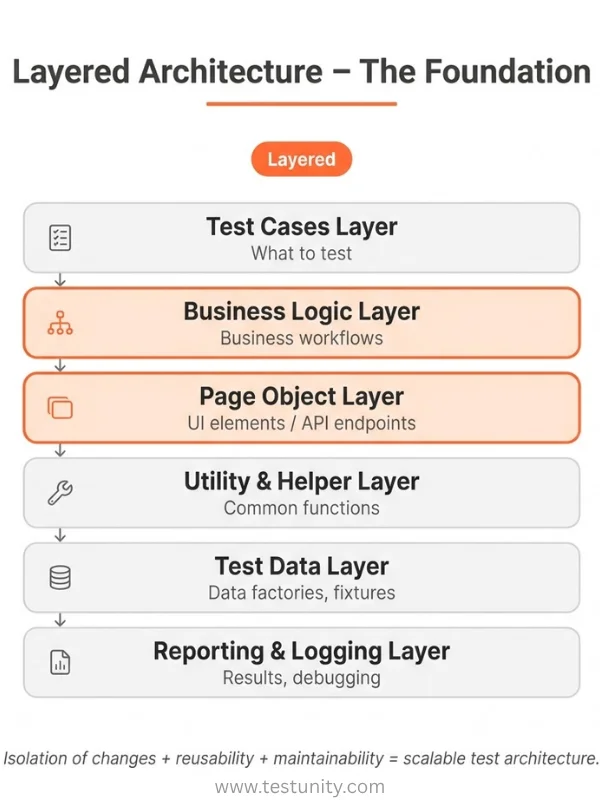
A modular test automation framework typically uses a layered architecture:
┌─────────────────────────────────────┐
│          Test Cases Layer           │  ← What to test
├─────────────────────────────────────┤
│         Business Logic Layer        │  ← Business workflows
├─────────────────────────────────────┤
│         Page Object Layer           │  ← UI elements / API endpoints
├─────────────────────────────────────┤
│       Utility & Helper Layer        │  ← Common functions
├─────────────────────────────────────┤
│         Test Data Layer             │  ← Data factories, fixtures
├─────────────────────────────────────┤
│       Reporting & Logging Layer     │  ← Results, debugging
└─────────────────────────────────────┘
Why this works for test automation framework design:
-
Isolation of changes: UI changes only affect the Page Object Layer
-
Reusability: Business logic can be shared across tests
-
Testability: Each layer can be tested independently
-
Maintainability: Clear boundaries for new team members
Pattern 2: Page Object Model (POM)
The Page Object Model is the most fundamental test framework pattern for UI automation. It separates test logic from UI implementation details.
What it solves:
-
UI changes break only page objects, not tests
-
Test code becomes more readable
-
Locator reuse reduces duplication
Example (Java + Selenium):
// Page Object
public class LoginPage {
    private WebDriver driver;
    private By usernameField = By.id("username");
    private By passwordField = By.id("password");
    private By loginButton = By.cssSelector("button[type='submit']");

    public LoginPage(WebDriver driver) {
        this.driver = driver;
    }

    public DashboardPage login(String username, String password) {
        driver.findElement(usernameField).sendKeys(username);
        driver.findElement(passwordField).sendKeys(password);
        driver.findElement(loginButton).click();
        return new DashboardPage(driver);
    }
}

// Test Case
@Test
public void testValidLogin() {
    LoginPage loginPage = new LoginPage(driver);
    DashboardPage dashboard = loginPage.login("testuser", "TestPass123");
    assertTrue(dashboard.isUserLoggedIn());
}

Pattern 3: Factory Pattern for Test Data
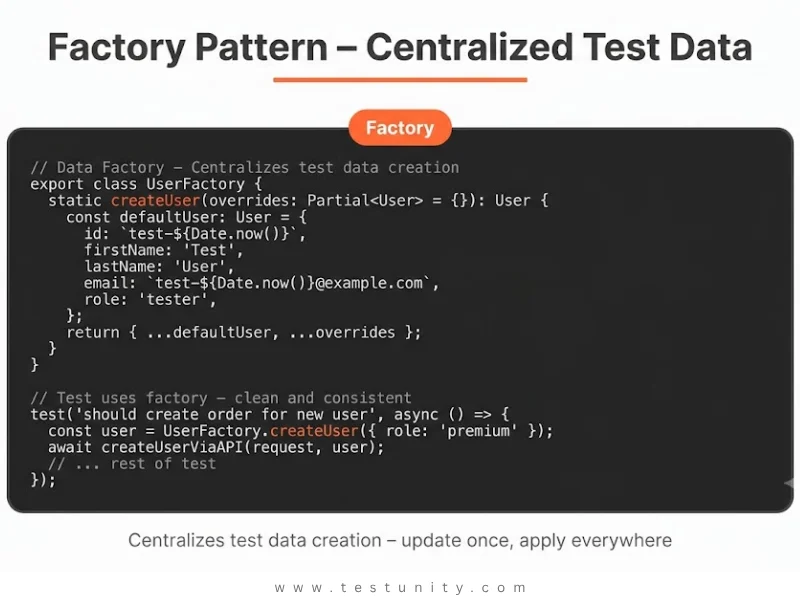
Test data management is a major pain point. The Factory pattern provides a clean way to create test data without spreading creation logic across tests.
What it solves for scalable test architecture:
-
Centralized test data creation
-
Consistent data generation
-
Easy updates when data structure changes
Example (TypeScript + Playwright):
// Data Factory
export class UserFactory {
  static createUser(overrides: Partial<User> = {}): User {
    const defaultUser: User = {
      id: `test-${Date.now()}`,
      firstName: 'Test',
      lastName: 'User',
      email: `test-${Date.now()}@example.com`,
      role: 'tester',
    };
    return { ...defaultUser, ...overrides };
  }
}

// Test
test('should create order for new user', async ({ page, request }) => {
  const user = UserFactory.createUser({ role: 'premium' });
  await createUserViaAPI(request, user);
  // ... rest of test
});
Pattern 4: Dependency Injection for Configuration
Configuration management becomes messy as your framework grows. Dependency injection (DI) provides a clean way to manage configuration, driver instances, and other shared dependencies.
Why it’s essential for test automation framework design:
-
Centralizes configuration management
-
Makes tests more predictable
-
Simplifies environment switching
Example (Python + pytest fixtures):
import pytest
from my_framework.config import Config
from my_framework.driver import DriverFactory

@pytest.fixture(scope="session")
def config():
    return Config.from_env()

@pytest.fixture(scope="function")
def driver(config):
    driver = DriverFactory.get_driver(config.browser)
    driver.get(config.base_url)
    yield driver
    driver.quit()

# Test uses injected dependencies
def test_login(driver, config):
    login_page = LoginPage(driver)
    dashboard = login_page.login(config.test_username, config.test_password)
    assert dashboard.is_loaded()

Advanced Architecture Patterns for Scale
Pattern 5: Service Object Pattern
For applications with complex APIs or multiple services, the Service Object pattern extends POM concepts to API testing.
public class PaymentService {
    private RestClient client;

    public PaymentService(RestClient client) {
        this.client = client;
    }

    public PaymentResponse processPayment(PaymentRequest request) {
        return client.post("/payments", request)
                    .body()
                    .as(PaymentResponse.class);
    }
}
Pattern 6: Test Context Pattern
Managing test state across large suites is challenging. The Test Context pattern provides a clean way to share data between test steps and test stages.
// Test Context
class TestContext {
  private data: Map<string, any> = new Map();

  set(key: string, value: any): void {
    this.data.set(key, value);
  }

  get<T>(key: string): T {
    return this.data.get(key) as T;
  }
}

// Usage
test('checkout flow', async () => {
  context.set('productId', 'prod-123');
  // test logic...
  const productId = context.get<string>('productId');
});
Pattern 7: Parallel Execution Pattern
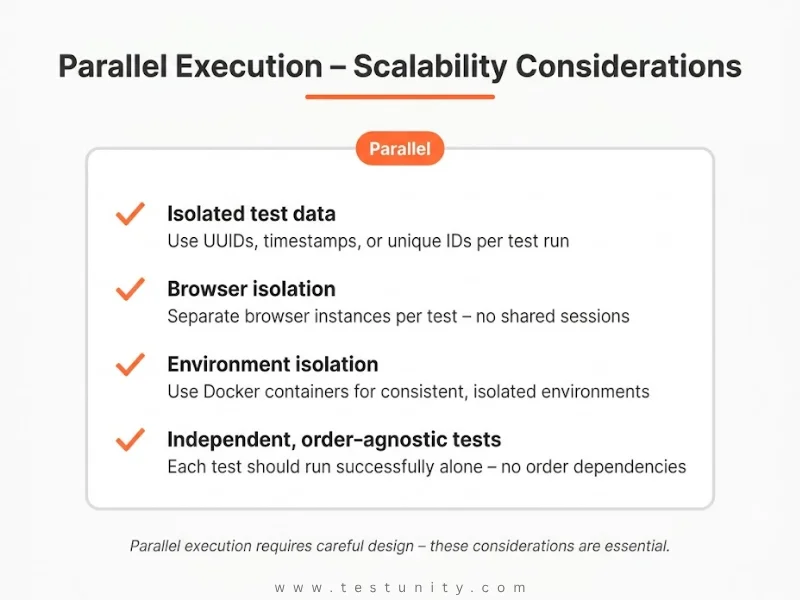
Scalability means running tests in parallel. This requires specific test framework design decisions:
Key considerations for scalable test architecture:
| Consideration | Solution |
|---|---|
| Isolated test data | Unique data per test (UUIDs, timestamps) |
| Browser isolation | Separate browser instances per test |
| Environment isolation | Containerized environments (Docker) |
| Test dependencies | Independent, order-agnostic tests |
| Resource limits | Test sharding across multiple workers |
Choosing the Right Architecture for Your Needs
Different scenarios require different architectures:
| Project Type | Recommended Approach |
|---|---|
| Small project (<50 tests) | Simple POM + utilities |
| Medium project (50-500 tests) | Layered architecture + data factories |
| Large project (500+ tests) | Service objects + dependency injection + parallel execution |
| Enterprise (multiple teams) | Micro-frameworks (shared core, domain-specific extensions) |

Common Anti-Patterns to Avoid in Test Automation Framework Design
Anti-Pattern 1: God Objects
Large, monolithic page objects that know too much.
Fix: Break into smaller, focused objects.
Anti-Pattern 2: Test Logic in Test Methods
Complex if/else logic inside test methods.
Fix: Move logic to business layer.
Anti-Pattern 3: Hard-Coded Test Data
Test data scattered across test files.
Fix: Use data factories or external data sources.
Summary: What Changed in This Optimization
| Element | Before | After |
|---|---|---|
| SEO Title | Missing keyword | Test Automation Framework Design: Scalable Architecture Patterns That Last |
| Meta Description | Missing keyword | Test automation framework design is critical for long-term success... |
| URL | 94 characters | test-automation-framework-design-scalable-architecture (65 characters) |
| Keyword Density | 0.79% | ~1.2% |
| Internal Links | 0 | Added 3 links to existing content |
| Image Alt Text | Missing | Added with focus keyword |
Related Resources
-
Test Automation Strategy: How to Plan, Execute, and Scale – Strategy → architecture
-
Testing Anti-Patterns: 10 Common Mistakes That Ruin Test Suites – Anti-patterns to avoid
-
Why Are My Tests So Slow? 7 Quick Fixes – Performance optimization

TestUnity is a leading software testing company dedicated to delivering exceptional quality assurance services to businesses worldwide. With a focus on innovation and excellence, we specialize in functional, automation, performance, and cybersecurity testing. Our expertise spans across industries, ensuring your applications are secure, reliable, and user-friendly. At TestUnity, we leverage the latest tools and methodologies, including AI-driven testing and accessibility compliance, to help you achieve seamless software delivery. Partner with us to stay ahead in the dynamic world of technology with tailored QA solutions.



Leave a Reply