

Your test suite is failing you. Tests are flaky, slow, and hard to maintain. You spend more time fixing broken tests than catching bugs. This is the reality of testing anti-patterns – common mistakes that turn your test suite from a safety net into a burden.
Testing anti-patterns are recurring, ineffective, or counterproductive approaches to writing and maintaining tests. They produce unreliable tests, false confidence, and heavy maintenance costs . Recognizing and fixing these test suite mistakes is essential for building a maintainable, trustworthy test suite.
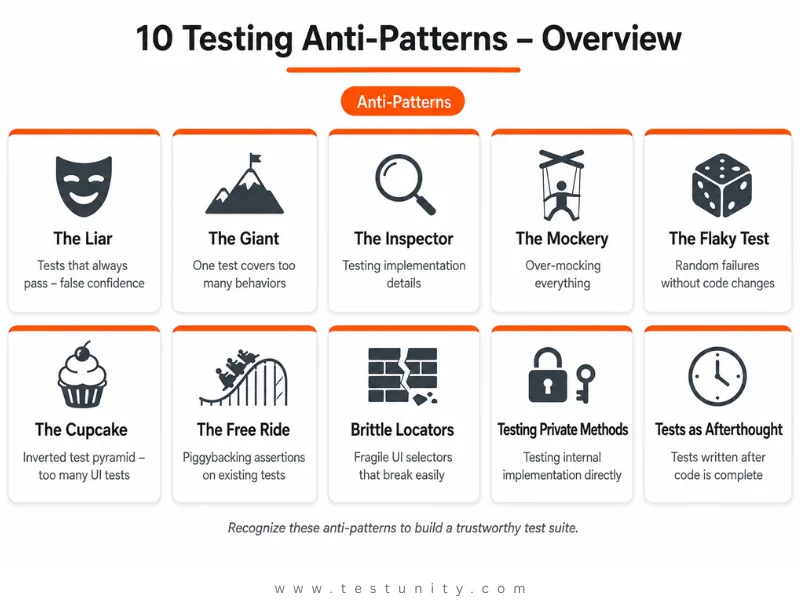
This guide covers 10 critical testing anti-patterns, why they happen, and exactly how to fix them. Think of it as your test maintenance playbook.
The Short Answer
Testing anti-patterns are common mistakes that make test suites unreliable and expensive to maintain. The 10 most damaging anti-patterns include: The Liar (tests that always pass), The Giant (tests too large), The Inspector (testing implementation details), The Mockery (over-mocking), The Flaky Test (random failures), The Cupcake (inverted test pyramid), The Free Ride (piggybacking assertions), Brittle Locators (fragile UI tests), testing private methods, and Tests as Afterthought. Each has a clear fix: focus on behavior, not implementation; keep tests focused; use mocks sparingly; and write tests alongside code.
Anti-Pattern 1: The Liar – Tests That Always Pass
The Problem
A test that always passes, even when the code is broken, is a testing anti-pattern called “The Liar” . These tests give false confidence and hide real bugs.
Code smell:
// BAD - Always passes because it tests nothing meaningful
it('should process data', () => {
  const result = processData(input);
  expect(result).toBeDefined(); // Too weak
});
A test that only checks if something exists doesn’t verify that it works correctly. The test could pass while the actual behavior is completely wrong.
What causes this testing anti-pattern:
-
Writing tests to pass, not to fail first
-
Using weak assertions
-
No clear expected outcome
The Fix
Always verify specific, observable behavior.
// GOOD - Actually verifies behavior
it('should transform input to uppercase', () => {
  const result = processData({ text: 'hello' });
  expect(result.text).toBe('HELLO');
});

Detection strategy: Deliberately break the implementation. If the test still passes, it’s a Liar . Every test should fail when the behavior it’s testing is broken.
Anti-Pattern 2: The Giant – Tests That Are Too Large
The Problem
One test covering too many behaviors is a common testing anti-pattern called “The Giant” . These tests are hard to debug because when they fail, you don’t know which behavior is broken.
Code smell:
// BAD - Tests multiple things
it('should handle user registration', async () => {
  const user = await register(userData);
  expect(user.id).toBeDefined();
  expect(user.email).toBe(userData.email);
  expect(user.password).toBeUndefined();
  expect(sendEmail).toHaveBeenCalled();
  expect(createProfile).toHaveBeenCalled();
  // ... 20 more assertions
});
What causes this testing anti-pattern:
-
Desire to minimize test count
-
Reusing setup code instead of splitting tests
-
Not understanding the value of focused tests
The Fix
One test, one logical assertion concept.
// GOOD - Focused tests
it('should create user with provided email', async () => {
  const user = await register(userData);
  expect(user.email).toBe(userData.email);
});

it('should send welcome email on registration', async () => {
  await register(userData);
  expect(sendEmail).toHaveBeenCalledWith(
    expect.objectContaining({ type: 'welcome' })
  );
});
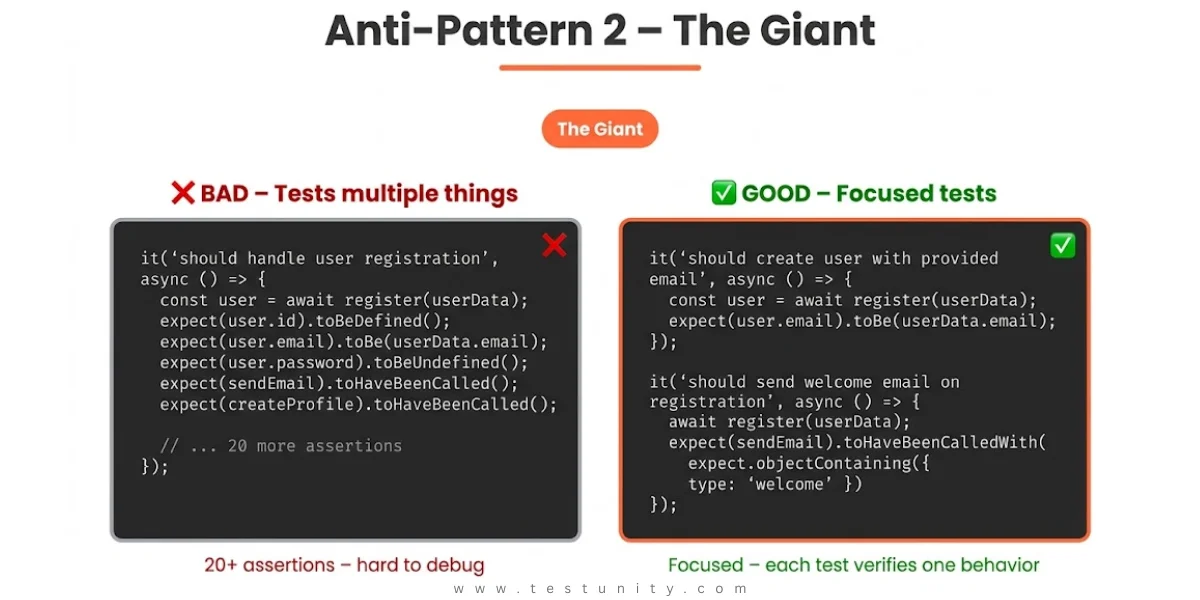
The benefit: When a focused test fails, you immediately know what’s broken. No detective work required .
Anti-Pattern 3: The Inspector – Testing Implementation Details
The Problem
Testing how the code works, not what it does, is a testing anti-pattern called “The Inspector” . These tests break every time you refactor, even when the behavior stays the same.
Code smell:
// BAD - Tests internal implementation
it('should use QuickSort for sorting', () => {
  const sorter = new Sorter();
  const spy = jest.spyOn(sorter, '_quickSort');
  sorter.sort([3, 1, 2]);
  expect(spy).toHaveBeenCalled();
});
What causes this testing anti-pattern:
-
Testing private methods directly
-
Spying on internal method calls
-
Testing method call order
Real impact: A test that mirrors the implementation will fail when the implementation changes, even if the public behavior is correct. You’re testing the code, not the contract .
The Fix
Test behavior, not implementation.
// GOOD - Tests behavior/output
it('should return sorted array', () => {
  const sorter = new Sorter();
  expect(sorter.sort([3, 1, 2])).toEqual([1, 2, 3]);
});
The test passes regardless of whether the sorting algorithm uses QuickSort, MergeSort, or any other implementation . It only cares about the result.
![The Inspector anti-pattern: BAD test spies on internal method _quickSort (breaks on refactor). GOOD test verifies behavior – expects sorted array [1,2,3] regardless of implementation. Orange right panel border and orange ‘The Inspector’ badge.](data:image/svg+xml;base64,PHN2ZyB4bWxucz0iaHR0cDovL3d3dy53My5vcmcvMjAwMC9zdmciIHZpZXdCb3g9IjAgMCAxMjAwIDYwMCIgd2lkdGg9IjEyMDAiIGhlaWdodD0iNjAwIiBidi1pbWctdXJsPSJodHRwczovL2Jsb2cudGVzdHVuaXR5LmNvbS93cC1jb250ZW50L3VwbG9hZHMvYWxfb3B0X2NvbnRlbnQvSU1BR0UvYmxvZy50ZXN0dW5pdHkuY29tL3dwLWNvbnRlbnQvdXBsb2Fkcy8yMDI2LzA4L0FudGktUGF0dGVybi0zLeKAky1UaGUtSW5zcGVjdG9yLnBuZy5idi53ZWJwIiBidi1yZXNpemVkLWluZm9zPSJZblpmY21WemFYcGxaRjl0YjJKcGJHVXVjRzVuT2pRNE1Db3lOREE3WW5aZmNtVnphWHBsWkY5cGNHRmtMbkJ1WnpvNE1qQXFOREV3TzJKMlgzSmxjMmw2WldSZlpHVnphM1J2Y0M1d2JtYzZNVEl3TUNvMk1EQT0iPjwvc3ZnPg==)
The benefit: You can refactor freely. As long as the public behavior remains correct, your tests pass.
Anti-Pattern 4: The Mockery – Over-Mocking Everything
The Problem
Replacing every collaborator with a mock is a testing anti-pattern called “The Mockery” . These tests mirror the implementation: every refactor that moves a method breaks tests that didn’t fail for any production reason .
Code smell:
// BAD - Everything is mocked, test proves nothing
it('should calculate price', () => {
  const mockProduct = { getPrice: jest.fn().mockReturnValue(100) };
  const mockDiscount = { apply: jest.fn().mockReturnValue(80) };
  const mockTax = { calculate: jest.fn().mockReturnValue(8) };

  const total = calculateTotal(mockProduct, mockDiscount, mockTax);
  expect(total).toBe(88); // Just testing mock arithmetic
});
What causes this testing anti-pattern:
-
Fear of integration complexity
-
Habit of mocking every dependency
-
Not distinguishing between external and internal dependencies
Warning sign: When the mock setup takes more lines than the test itself, you have a problem .
The Fix
Only mock what’s necessary to keep the test deterministic.
// GOOD - Use real objects where feasible
it('should apply 20% discount to price', () => {
  const product = new Product({ price: 100 });
  const discount = new PercentageDiscount(20);

  const total = calculateTotal(product, discount);
  expect(total).toBe(80);
});
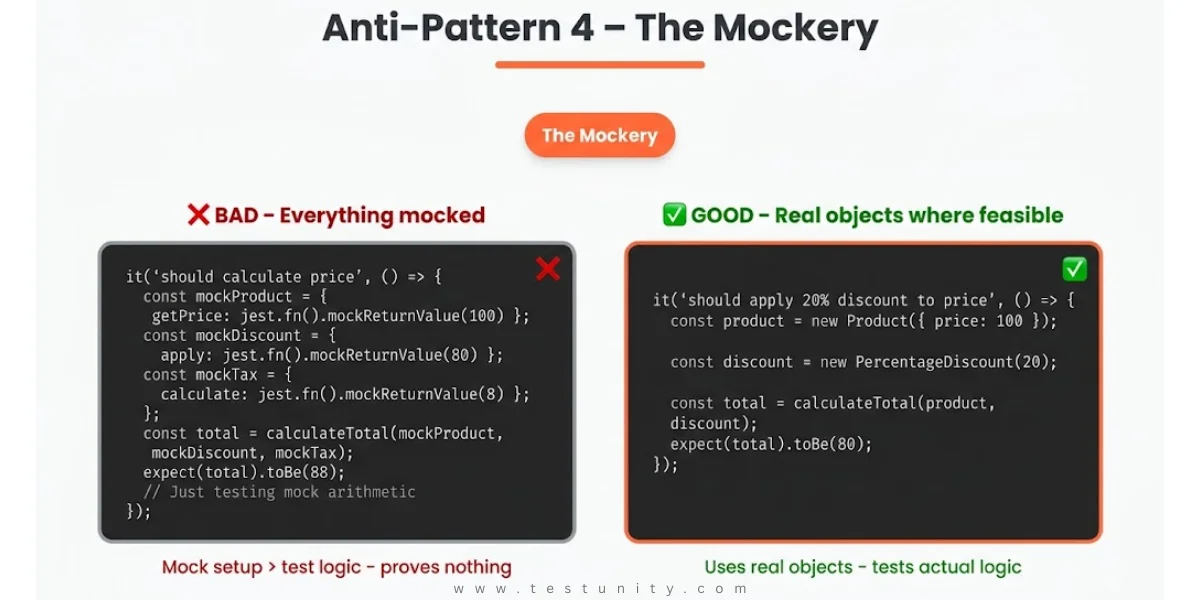
The principle: Only mock external dependencies and side effects (APIs, databases, file systems). Use real objects for value objects, domain models, and in-memory repositories .
Anti-Pattern 5: The Flaky Test – Random Failures
The Problem
A test that sometimes passes and sometimes fails, without code changes, is a testing anti-pattern called “The Flaky Test” . Flaky tests erode trust in the entire test suite. When tests fail randomly, teams start ignoring failures .
What causes this testing anti-pattern:
-
Time-dependent logic
-
Race conditions in async code
-
Shared mutable state
-
External dependencies
-
Brittle locators
Real impact: Flaky tests make CI unreliable. According to a Bitrise study, the proportion of teams experiencing test flakiness grew from 10% in 2022 to 26% in 2025 .
The Fix
Eliminate non-determinism.
Common fixes:
| Cause | Fix |
|---|---|
| Hardcoded waits | Replace with smart waits |
| Shared state | Isolate test data |
| Time-dependent assertions | Use fixed time, not new Date() |
| Brittle locators | Use stable selectors (IDs, data attributes) |
| Async race conditions | Use proper async/await patterns |
Detection strategy: Run tests multiple times. If they fail inconsistently, they’re flaky. Fix them or quarantine them .
For more on fixing flaky tests, see our Flaky Tests guide.
Anti-Pattern 6: The Cupcake – Inverted Test Pyramid
The Problem
An inverted test pyramid – too many UI tests, not enough unit or integration tests – is a testing anti-pattern called “The Cupcake” . UI tests are slow, brittle, and expensive to maintain .
What causes this testing anti-pattern:
-
Different teams writing different test levels
-
Work happening sequentially (waterfall style)
-
No collaboration between developers and testers
-
Measuring “scenarios automated” instead of “automation coverage”
Real impact: UI tests can take 10-100x longer than unit tests. When your test suite is UI-heavy, you get slow feedback loops and high maintenance costs .

The Fix
Follow the Test Automation Pyramid.
| Level | Tests | Why |
|---|---|---|
| Base (Most) | Unit tests | Fast, reliable, cheap to run |
| Middle | Integration/API tests | Verify component interactions |
| Top (Fewest) | UI/E2E tests | Only for critical user journeys |
Collaboration is key: recommends:
-
Cross-role pairing between developers and testers
-
Working in sync, not sequentially
-
Story kickoffs (Three Amigos) to agree on testing strategy
-
Testing at the lowest level possible
-
Sharing metrics across all testing levels
The goal: 70% unit, 20% integration, 10% UI.
Anti-Pattern 7: The Free Ride – Piggybacking Assertions
The Problem
Adding extra assertions to an existing test instead of writing a new one is a testing anti-pattern called “The Free Ride” . It creates tests that test multiple things and adds logic inside the test case .
Code smell:
// BAD - Free ride with if/else logic
it('Page.Events.RequestFailed', async () => {
  // Setup...
  if (isChrome)
    expect(failedRequests[0].failure().errorText).toBe('net::ERR_FAILED');
  else
    expect(failedRequests[0].failure().errorText).toBe('NS_ERROR_FAILURE');
});
What causes this testing anti-pattern:
-
Wanting to reuse setup code
-
Not wanting to write a separate test
-
Logic inside the test case
The Fix
One behavior per test. Split conditional logic into separate tests.
// GOOD - Separate tests for each behavior
itChromeOnly('Page.Events.RequestFailed on Chrome', async () => {
  // Chrome-specific setup and assertions
});

itFirefoxOnly('Page.Events.RequestFailed on Firefox', async () => {
  // Firefox-specific setup and assertions
});
If you’re worried about duplication, use test fixtures or beforeEach hooks to share setup code .
Anti-Pattern 8: Brittle Locators – Fragile UI Tests
The Problem
Using unstable XPath expressions or dynamic IDs is a common testing anti-pattern that makes UI tests fragile . When a developer renames a class, modifies an ID, or updates a layout, tests break across the entire suite .
Code smell:
// BAD - Brittle locators
cy.get('#product-123456')  // Dynamic ID that changes
cy.get('div:nth-child(3) > .product-card:nth-child(2)')  // Fragile XPath
What causes this testing anti-pattern:
-
Relying on auto-generated IDs
-
Using position-based selectors
-
Not using data attributes for test selection
The Fix
Use stable, semantic selectors.
// GOOD - Stable locators
cy.get('[data-testid="product-card"]')  // Data attribute
cy.get('.product-card').first()  // Class if stable
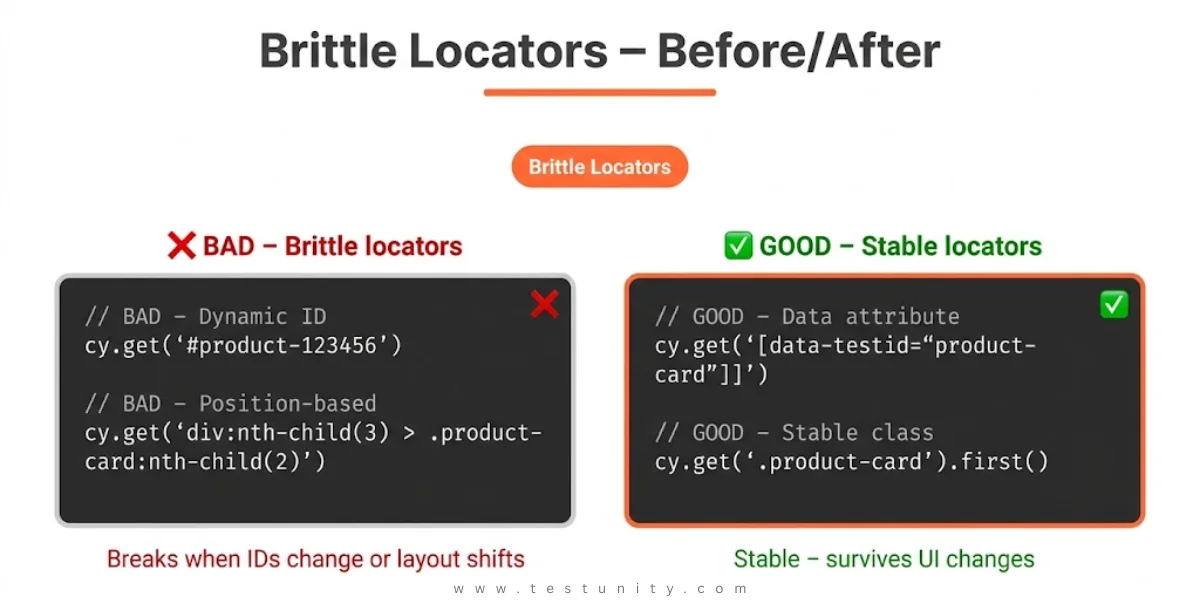
Best practices:
-
Use
data-testidordata-testattributes for elements you need to select in tests -
Avoid dynamic IDs
-
Use the Page Object Model to isolate locators
When using the Page Object Model, you update locators in one place instead of across every test .
Anti-Pattern 9: Testing Private Methods Directly
The Problem
Making methods public, protected, or package-private specifically so tests can call them is a testing anti-pattern . This couples the test to the internal structure of the class and breaks every time the implementation is refactored .
Code smell:
// BAD - Method made public only for testing
public class OrderProcessor {
    public boolean validateInput(String input) {  // Should be private
        // ...
    }
}
What causes this testing anti-pattern:
-
Not understanding how to test behavior through public APIs
-
Testing implementation instead of behavior
The Fix
Drive private logic through the public method that uses it.
// GOOD - Test behavior through public API
@Test
public void testProcessorRejectsInvalidOrder() {
    Order order = new Order(/* invalid data */);
    OrderProcessor processor = new OrderProcessor();
    Result result = processor.process(order);
    assertThat(result).isRejected();
}

The principle: If a private behavior is worth testing, it’s reachable through a public method that exercises it. If no public method exercises it, the private code is dead and should be deleted .
Alternative: Extract the private logic into a collaborator with its own public surface and test that collaborator .
Anti-Pattern 10: Tests as Afterthought
The Problem
Writing tests after the code is complete is a testing anti-pattern that leads to low-quality tests . When tests are written to pass, not to fail first, they often don’t verify behavior properly.
Red flags:
-
PR has implementation commits, then “add tests” commit
-
Tests written after code review
-
“I’ll add tests next” or “Tests coming soon”
-
Tests that can’t fail (no assertions or weak assertions)
Code smell:
// BAD - Tests as afterthought
test('feature works', () => {
  const result = newFeature();
  expect(result).toBe(result);  // Always passes
});

test('feature runs', () => {
  newFeature();  // No expect()
});
The Fix
Write tests alongside code, or even before it.
Good practices:
-
Test-Driven Development (TDD): write the test, watch it fail, then write code
-
Include tests in the same commit as implementation
-
For bug fixes: write a failing test that reproduces the bug before fixing it
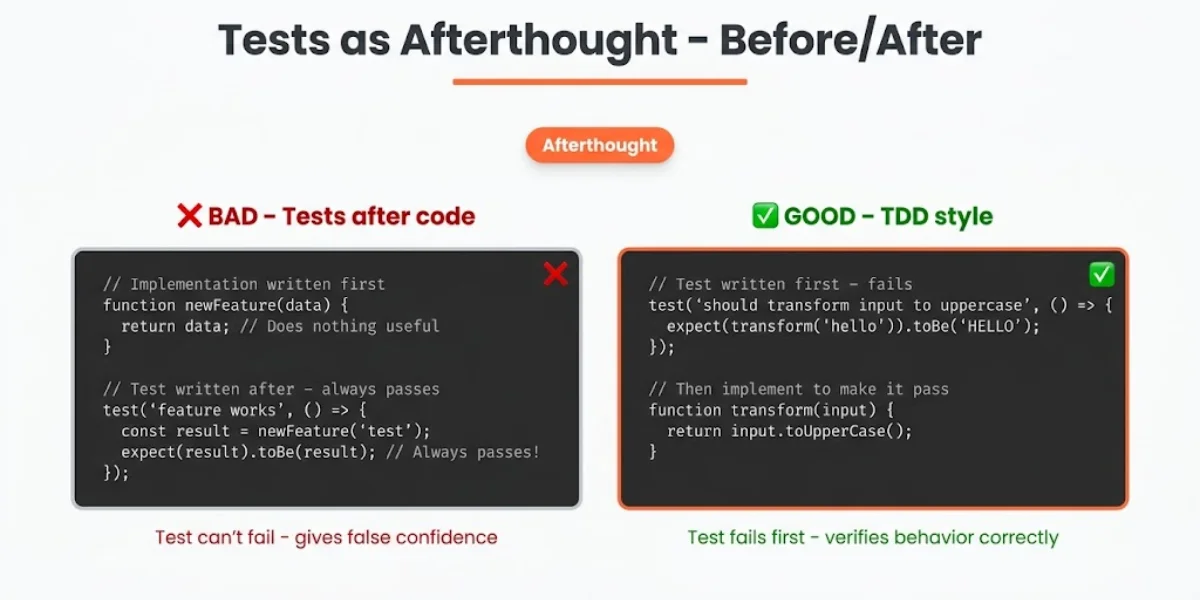
The benefit: Tests written first are more likely to verify behavior properly. They also help you design better APIs.
How to Fix Your Test Suite: A Step-by-Step Action Plan
| Step | Action | Anti-Patterns Addressed |
|---|---|---|
| 1 | Audit your test suite. Identify duplicate tests, flaky tests, and tests with no assertions. | All |
| 2 | Quarantine flaky tests so they don’t block CI. | The Flaky Test |
| 3 | Replace brittle locators with stable selectors. | Brittle Locators |
| 4 | Refactor large tests into smaller, focused tests. | The Giant |
| 5 | Replace implementation tests with behavior tests. | The Inspector, Testing Private Methods |
| 6 | Review mocks – only mock external dependencies. | The Mockery |
| 7 | Adopt the Page Object Model for UI tests. | Brittle Locators, Test Maintenance |
| 8 | Run test suite audits regularly – remove obsolete tests. | All |
Related Resources
-
How to Fix Flaky Tests – Deep dive on flaky test anti-pattern
-
Why Are My Tests So Slow? 7 Quick Fixes – Speed up your test suite
-
My CI Pipeline Fails Because of Tests – Fix CI test failures
-
Test Automation Strategy – Build a maintainable automation suite
-
How to Write Effective Test Cases – Write better tests from the start
-
Risk-Based Testing – Prioritize what matters

TestUnity is a leading software testing company dedicated to delivering exceptional quality assurance services to businesses worldwide. With a focus on innovation and excellence, we specialize in functional, automation, performance, and cybersecurity testing. Our expertise spans across industries, ensuring your applications are secure, reliable, and user-friendly. At TestUnity, we leverage the latest tools and methodologies, including AI-driven testing and accessibility compliance, to help you achieve seamless software delivery. Partner with us to stay ahead in the dynamic world of technology with tailored QA solutions.



Leave a Reply